
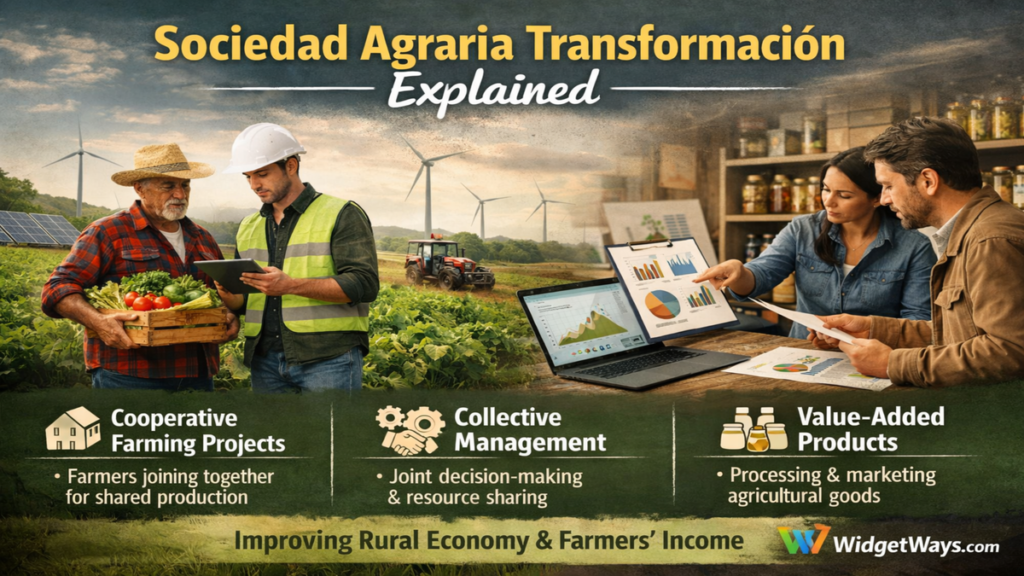

When I first began examining Spain’s rural economy, one organizational model kept appearing in policy documents, agricultural reports, and regional development plans: the Sociedad Agraria de Transformación, commonly known by its acronym, SAT. For farmers across Spain, SATs have become a pragmatic solution to an enduring rural challenge. Small and medium producers must compete in a globalized agricultural market while preserving the economic viability of family farms.
In simple terms, a Sociedad Agraria de Transformación is a legal association created by farmers, ranchers, or rural entrepreneurs to collectively produce, process, or market agricultural goods. The structure emerged formally under Spain’s Royal Decree 1776/1981, which defined SATs as civil societies with an economic and social purpose aimed at agricultural production, transformation, commercialization, and rural development.
What makes SATs distinctive is their hybrid character. They operate like entrepreneurial companies while preserving elements of collective organization typical of cooperatives. Members pool capital, share infrastructure, and coordinate production strategies. Yet unlike traditional cooperatives, voting rights and financial decisions may reflect capital participation rather than the classic “one member, one vote” principle.
Over the last four decades, this model has helped thousands of Spanish farmers modernize production, scale operations, and enter export markets. From citrus producers in Andalusia to vineyard growers in Castilla-La Mancha, SATs have reshaped local agricultural landscapes. They illustrate how institutional design can bridge the gap between individual farming traditions and the demands of contemporary agribusiness.
Understanding how these societies function reveals a broader story about rural resilience, collective entrepreneurship, and the evolving architecture of Europe’s agricultural economy.
Origins of the Sociedad Agraria de Transformación
The roots of the SAT model lie in Spain’s long tradition of rural association. For centuries, farmers relied on informal partnerships, irrigation communities, and shared labor arrangements to manage land and resources. However, the modernization of agriculture during the twentieth century required more formal structures capable of handling investment, processing infrastructure, and market coordination.
The Spanish government introduced the legal framework for SATs in 1981 through Royal Decree 1776/1981, providing farmers with a formal mechanism to collaborate economically while maintaining flexibility. The decree defined SATs as entities dedicated to producing, transforming, and marketing agricultural, livestock, or forestry products while improving rural development and providing shared services to members.
This legal recognition arrived at a crucial moment. Spain was preparing for integration into European markets and anticipating entry into the European Economic Community in 1986. Rural producers needed structures that could compete with large agricultural enterprises while maintaining the independence of individual farms.
Agricultural economists frequently note that SATs emerged as a pragmatic alternative to cooperatives. While cooperatives were rooted in social economy principles, many farmers sought greater managerial autonomy and flexibility in capital contributions. The SAT framework offered precisely that balance.
As agricultural scholar Cynthia Giagnocavo observed in research on Spanish agri-food organizations, collective entities like SATs allowed independent farmers to retain ownership of production while coordinating processing and commercialization activities. Such arrangements reduced costs and strengthened bargaining power in the supply chain.
The result was a distinctive Spanish innovation in agricultural governance that remains widely used today.
Legal Structure and Governance
The governance structure of a Sociedad Agraria de Transformación reflects a blend of partnership law and cooperative practice. Legally, SATs are classified as civil societies with legal personality once registered in the national SAT registry maintained by Spain’s Ministry of Agriculture.
This legal identity grants them the capacity to own property, sign contracts, and operate as independent economic entities. The assets of the organization remain separate from the personal assets of its members, although members may hold subsidiary responsibility depending on statutory provisions.
Membership is typically limited to individuals or entities engaged in agricultural activities. These may include farmers, livestock producers, forestry operators, or agricultural service providers.
Unlike many cooperatives, SAT governance allows voting rights to be linked to capital contributions in certain decisions. This design introduces a more corporate-like dynamic, encouraging financial investment and strategic planning.
Agricultural law expert Belén Gilabert has written that SATs occupy a “middle ground between cooperative ideology and business pragmatism,” providing rural producers with a structure capable of responding to market demands without abandoning collaborative values.
The following table summarizes the core legal features of SATs.
| Feature | Description |
|---|---|
| Legal basis | Royal Decree 1776/1981 |
| Legal classification | Civil society with economic and social purpose |
| Membership | Farmers or agricultural stakeholders |
| Activities | Production, processing, marketing, rural development |
| Governance | Statutes define voting rights and capital contributions |
| Liability | Shared responsibility depending on statutes |
These governance mechanisms help explain why SATs remain attractive for producers seeking collaboration without heavy administrative burdens.
SATs in the Landscape of Agricultural Organizations
Spain’s agricultural economy includes several forms of collective organization: cooperatives, producer organizations, commercial partnerships, and SATs. Each structure serves a distinct function.
SATs are frequently described as the second most common form of collective agricultural entrepreneurship after cooperatives.
Where cooperatives emphasize democratic governance and open membership, SATs prioritize operational efficiency and capital-based participation. This distinction affects how decisions are made, how profits are distributed, and how new members are admitted.
In practice, SATs often operate in sectors requiring coordinated investment, such as irrigation systems, packaging facilities, greenhouses, or processing plants.
Agricultural sociologist José Luis Monzón of CIRIEC-Spain has noted that the diversity of organizational forms in the rural economy strengthens resilience. “Plural institutional models allow farmers to adapt to different market conditions and production scales,” he argues.
The coexistence of cooperatives and SATs therefore reflects not competition but complementarity within the agricultural sector.
Below is a comparison of the two most prominent forms of farmer collaboration in Spain.
| Characteristic | Agricultural Cooperative | SAT |
|---|---|---|
| Voting principle | One member, one vote | Often proportional to capital |
| Membership | Open and voluntary | Defined by statutes |
| Capital structure | Variable capital | Defined share participation |
| Legal classification | Cooperative enterprise | Civil society |
| Typical use | Collective marketing | Production, transformation, services |
Understanding these distinctions helps policymakers tailor agricultural support programs to different organizational needs.
Economic Role in Rural Development
SATs have played a significant role in the modernization of Spanish agriculture. Many operate in high-value sectors such as citrus, olives, wine, horticulture, and livestock production.
A notable example is the SAT Cítricos del Andarax in southeastern Spain, which helped restructure citrus production in the region by coordinating farmer output and marketing strategies.
Through collective investment, SAT members can access equipment and technologies that would be prohibitively expensive for individual farmers. These may include cold storage facilities, automated irrigation systems, sorting machinery, or export logistics.
The economic impact extends beyond individual farms. SATs often create local employment through processing plants, packaging facilities, and administrative services. In rural regions facing population decline, these organizations can become anchors of economic activity.
According to rural development research, collaborative agricultural organizations also strengthen farmers’ bargaining power in the supply chain. When producers market goods collectively, they gain leverage in negotiations with wholesalers, supermarkets, and exporters.
Agricultural economist Antonio Muñoz-Cañavate emphasizes that knowledge-sharing within these networks also improves innovation. Farmers exchange information on production techniques, environmental practices, and market trends.
Such cooperation transforms isolated producers into participants in a broader rural economy.
Social and Community Impact
While SATs are often discussed in economic terms, their social significance is equally important. Rural communities frequently rely on these organizations to maintain livelihoods, stabilize agricultural incomes, and preserve regional identity.
In many villages, SATs function as social institutions as well as business entities. Members meet regularly to discuss production strategies, coordinate planting schedules, and share experiences from the field.
Sociologists studying Spain’s rural transformation argue that these associations strengthen what economists call “social capital.” Farmers develop trust networks that facilitate cooperation beyond formal agreements.
A 2022 study on agri-food organizations found that strong social capital significantly improves cooperative performance and international orientation.
Environmental sustainability also plays an increasing role in SAT activities. Many organizations adopt collective approaches to water management, integrated pest control, and sustainable soil practices.
Rural development researcher Emilio Mauleón has observed that SATs align closely with broader principles of the social economy. Their dual objectives of economic efficiency and community development distinguish them from purely profit-driven agribusiness firms.
These social dimensions help explain why SATs persist even as agricultural markets become more industrialized.
Expert Perspectives on SATs
Experts across agricultural policy and rural economics recognize the importance of these organizations.
Dr. Cynthia Giagnocavo, a researcher specializing in agricultural cooperatives, has written that collective structures such as SATs allow small farmers to compete in globalized food markets without abandoning local production traditions.
Similarly, a report from Wageningen University notes that SATs combine features of partnerships and companies, enabling flexible governance while maintaining collaborative goals.
Policy analysts also emphasize their role in innovation. According to rural development scholar José Luis Monzón, “collective entrepreneurship is essential for the modernization of small-scale agriculture in Europe.”
These perspectives highlight how institutional design shapes economic outcomes in rural environments.
Challenges Facing SATs Today
Despite their advantages, SATs face several contemporary challenges.
Global agricultural markets have become increasingly competitive, placing pressure on producers to scale operations and adopt new technologies. Smaller SATs may struggle to finance modernization projects or maintain profitability.
Climate change also presents a growing concern. Mediterranean agriculture faces rising temperatures, water scarcity, and shifting rainfall patterns. Organizations must invest in resilient irrigation systems and climate-adaptive crop varieties.
Another challenge involves generational renewal. Rural populations across Spain are aging, and many farms lack successors. Without younger farmers joining SAT structures, some organizations risk declining membership.
Access to financing represents an additional obstacle. Agricultural investments often require significant capital, particularly in sectors such as greenhouse production or mechanized harvesting.
Nevertheless, policymakers increasingly recognize that collaborative structures like SATs can help address these challenges by pooling resources and spreading risk among members.
Future of Agricultural Transformation Societies
The future of SATs will likely be shaped by three major forces: sustainability, technological innovation, and global market integration.
Digital agriculture tools such as satellite monitoring, precision irrigation, and data-driven crop management are becoming more accessible. SATs may serve as platforms for collective adoption of these technologies.
European agricultural policy also encourages collaborative structures that support sustainable production. Programs under the Common Agricultural Policy (CAP) often prioritize farmer organizations that promote environmental stewardship and rural resilience.
In addition, international demand for Mediterranean products such as olive oil, wine, and citrus continues to grow. SATs that coordinate export strategies may help farmers capture greater value from global markets.
Ultimately, the model’s longevity will depend on its ability to evolve while preserving the collaborative spirit that inspired its creation.
Key Takeaways
- A Sociedad Agraria de Transformación (SAT) is a Spanish legal entity allowing farmers to jointly produce, process, and market agricultural goods.
- The structure was formally established by Royal Decree 1776/1981.
- SATs blend cooperative collaboration with company-style governance and capital participation.
- They play a major role in rural development, enabling farmers to invest collectively in infrastructure and technology.
- Social capital and shared knowledge within SATs strengthen innovation and community resilience.
- Challenges include climate change, aging rural populations, and financing for modernization.
- Their future will depend on sustainability initiatives, technological adoption, and integration into global food markets.
Conclusion
Examining the Sociedad Agraria de Transformación reveals more than a legal structure. It offers insight into how farmers adapt to economic change while preserving the social fabric of rural life.
Throughout Spain’s agricultural regions, SATs illustrate a delicate balance between independence and cooperation. Individual farmers maintain ownership of their land and production decisions, yet they collaborate strategically to access markets, technology, and infrastructure that would otherwise remain out of reach.
This hybrid model reflects a broader trend in modern agriculture. The challenges facing farmers today are too complex for isolated operations, yet many producers remain deeply attached to the autonomy of family farming.
SATs bridge that divide. They transform collaboration into a practical tool rather than an ideological commitment, allowing rural communities to modernize while retaining their identity.
As agriculture confronts climate uncertainty, technological disruption, and global competition, such adaptive institutional models may become increasingly important. Spain’s experience suggests that when farmers organize collectively without losing entrepreneurial flexibility, rural economies can remain resilient in an ever-changing world.
Read: Xanadu Project New Jersey: From Failure to American Dream
FAQs
What is a Sociedad Agraria de Transformación?
A Sociedad Agraria de Transformación (SAT) is a Spanish legal entity created by farmers to collectively produce, process, or market agricultural products while sharing resources and infrastructure.
When were SATs established in Spain?
SATs were formally regulated by Royal Decree 1776/1981, which established their legal framework and governance structure.
How do SATs differ from cooperatives?
Unlike cooperatives, SATs may allocate voting rights based on capital participation rather than strictly applying the “one member, one vote” rule.
Who can join a SAT?
Membership typically includes farmers, livestock producers, forestry operators, or individuals engaged in agricultural-related activities.
Why are SATs important for rural economies?
SATs allow farmers to pool resources, invest in infrastructure, and strengthen market power, helping rural communities remain economically viable.
References
Castilla-Polo, F., & Sánchez-Hernández, M. I. (2022). International orientation in Spanish agri-food cooperatives and social capital dynamics. Journal of Business Research.
Giagnocavo, C. (2002). Agricultural cooperatives: An analysis of legislative, policy and organizational frameworks in Spain. University of Almería.
Gobierno de España. (1981). Real Decreto 1776/1981 por el que se aprueba el estatuto que regula las Sociedades Agrarias de Transformación. Boletín Oficial del Estado. https://www.boe.es
Judis, R. (2012). Support for farmers’ cooperatives: Country report Spain. Wageningen University & Research.
Torres, J., et al. (2016). Restructuring the citrus sector in southeastern Spain. Sustainability, 8(9), 918.
Muñoz-Canavate, A. (2013). Information transfer in the agricultural sector in Spain. arXiv.
Monzón, J. L. (2019). Social economy and rural development in Europe. CIRIEC-Spain Research Reports.