
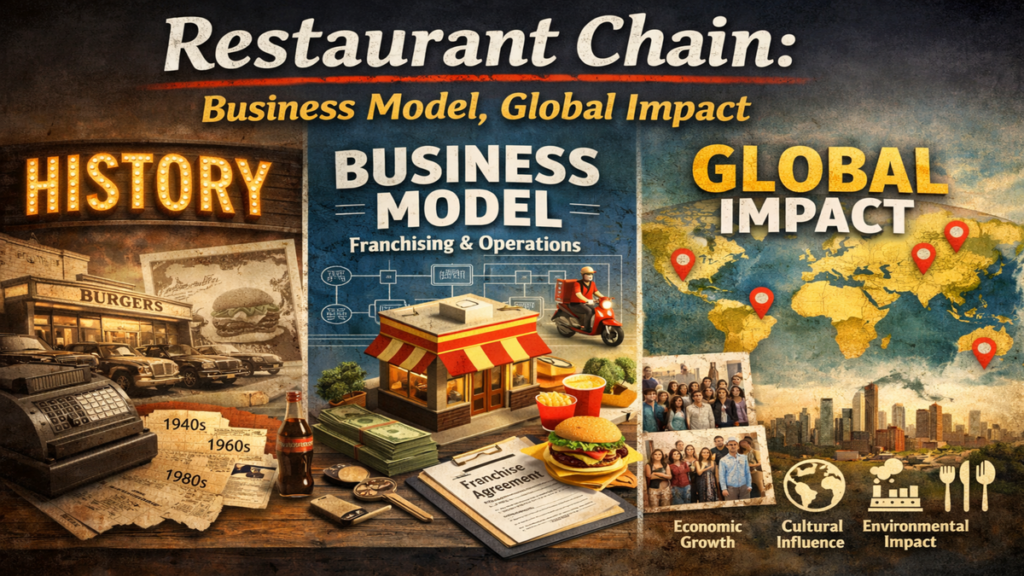

I have always found restaurant chains fascinating because they represent far more than convenient places to eat. At their core, restaurant chains are large-scale dining businesses that operate multiple locations under the same brand, menu, and operational model. The purpose of a restaurant chain is consistency: customers expect the same experience, food quality, and pricing whether they walk into a location in Chicago, Tokyo, or Dubai. Over the past century, restaurant chains have transformed global dining habits, turning local recipes into worldwide brands and shaping how people think about convenience, speed, and affordability in food.
The modern restaurant chain industry emerged in the early twentieth century alongside urbanization, automobile culture, and the growth of franchising. As cities expanded and highways connected communities, standardized dining concepts allowed businesses to scale rapidly while maintaining recognizable identities. Today the industry generates trillions of dollars annually and includes everything from fast-food giants to upscale casual dining brands.
Restaurant chains influence more than eating habits. They affect agricultural supply chains, employment patterns, marketing culture, and even architecture. Their rise reflects the broader forces of globalization, technological innovation, and consumer demand for convenience. Yet these businesses also face growing challenges, including shifting dietary preferences, environmental concerns, and competition from independent restaurants.
Understanding the evolution of restaurant chains reveals how food, economics, and culture intersect in the modern world. The story is not only about hamburgers and coffee shops but about the systems that deliver meals to billions of people every year.
The Origins of the Restaurant Chain Concept
The concept of the restaurant chain began taking shape in the early twentieth century when entrepreneurs recognized the value of standardized dining experiences. One of the earliest examples appeared in the United States with the rise of lunch counters and diners that replicated menus and service styles across multiple locations. These establishments offered simple meals at affordable prices, attracting workers in rapidly industrializing cities.
The development of franchising accelerated this trend. Franchising allowed a parent company to license its brand and operational model to independent owners who agreed to follow strict guidelines. This approach enabled rapid expansion without requiring companies to build and manage every location themselves. The model proved particularly effective in the food industry because recipes, cooking methods, and restaurant layouts could be standardized.
Fast-food restaurants became the most visible example of the chain model. In 1948, the McDonald brothers introduced a streamlined system for preparing hamburgers, fries, and milkshakes quickly and efficiently. When Ray Kroc later expanded the brand through franchising, McDonald’s became one of the most recognizable restaurant chains in the world. According to the company’s corporate history, the brand had more than 40,000 restaurants globally by 2023.
Food historian Andrew F. Smith notes that restaurant chains succeeded because they combined predictability with efficiency. Customers could rely on familiar menus while businesses benefited from economies of scale in purchasing ingredients and equipment.
The Franchising Model That Changed the Industry
Franchising became the backbone of the restaurant chain economy. Under this system, a franchisee invests capital to open a restaurant using the parent company’s brand, menu, and operating procedures. In return, the franchisee pays fees and royalties to the franchisor.
This model dramatically accelerated the growth of major chains. Instead of relying solely on corporate funding, brands could expand using the investments of thousands of individual entrepreneurs. Franchising also created local ownership opportunities, allowing operators to adapt to regional markets while maintaining brand consistency.
Many iconic restaurant chains built their success on franchising. Subway, founded in 1965 by Fred DeLuca and Peter Buck, expanded rapidly through this model and eventually became one of the largest restaurant chains by number of locations. Similarly, brands such as KFC, Burger King, and Domino’s Pizza relied heavily on franchise partnerships to reach international markets.
The structure of franchising typically includes several financial elements. Franchisees pay an initial fee to acquire the rights to operate under the brand. They also contribute a percentage of revenue as ongoing royalties and marketing contributions. In exchange, franchisors provide training, supply chains, marketing support, and standardized systems designed to maintain quality across locations.
| Franchise Element | Purpose | Impact on Restaurant Chains |
|---|---|---|
| Initial franchise fee | Brand licensing | Allows entrepreneurs to open locations |
| Royalty payments | Ongoing revenue for franchisor | Funds brand development |
| Training programs | Operational consistency | Ensures standardized food quality |
| Supply chain networks | Bulk ingredient purchasing | Reduces operational costs |
The result is a system that blends corporate structure with entrepreneurial ownership, allowing restaurant chains to scale globally.
The Global Expansion of Restaurant Chains
By the late twentieth century, restaurant chains had expanded far beyond their original markets. Globalization played a significant role in this transformation. As international travel increased and multinational corporations expanded, restaurant brands followed consumers into new regions.
The spread of American fast-food chains is often cited as a symbol of globalization. McDonald’s opened its first international location in Canada in 1967 and later entered markets across Europe, Asia, and Latin America. KFC, founded by Colonel Harland Sanders, achieved remarkable success in China after opening its first Chinese location in Beijing in 1987.
However, international expansion also required adaptation. Many chains adjusted their menus to reflect local tastes and cultural preferences. In India, for example, McDonald’s offers vegetarian options and avoids beef products due to cultural and religious considerations. In Japan, seasonal menu items incorporate regional ingredients and flavors.
Restaurant chains also compete with local brands that develop their own large-scale networks. In China, chains such as Dicos and Wallace have become major competitors to Western brands. Similarly, Japanese restaurant chains specializing in ramen, sushi, and convenience meals operate thousands of locations domestically and internationally.
| Region | Dominant Restaurant Chains | Key Characteristics |
|---|---|---|
| North America | McDonald’s, Starbucks, Subway | Large-scale franchising models |
| Asia | KFC, Yoshinoya, Dicos | Menu localization and regional flavors |
| Europe | Pret A Manger, Nando’s | Fast-casual dining emphasis |
| Middle East | Al Baik, Tim Hortons | Rapid urban expansion |
The global expansion of restaurant chains illustrates how food culture adapts within economic systems.
Technology and the Modern Restaurant Chain
Technology has transformed how restaurant chains operate and interact with customers. Digital ordering platforms, mobile applications, and delivery services have reshaped the dining experience. Customers can now place orders through smartphones, customize meals digitally, and track deliveries in real time.
Point-of-sale systems also generate valuable data about customer preferences. Chains analyze purchasing patterns to refine menus, adjust pricing strategies, and design targeted marketing campaigns. Artificial intelligence increasingly assists with demand forecasting, allowing restaurants to optimize inventory and reduce food waste.
Delivery platforms such as Uber Eats, DoorDash, and Deliveroo have further expanded the reach of restaurant chains. These services allow customers to order meals from multiple brands without leaving home. For restaurant operators, delivery platforms provide additional revenue streams but also introduce new logistical challenges.
Restaurant consultant Aaron Allen has noted that digital transformation is reshaping the industry’s competitive landscape. He explains that successful chains now operate as technology companies as much as food businesses.
The integration of technology also extends to kitchen operations. Automated cooking equipment, smart inventory systems, and robotics are beginning to appear in high-volume restaurant environments, improving efficiency and consistency.
Cultural Influence of Restaurant Chains
Restaurant chains have become deeply embedded in popular culture. Their logos, advertising campaigns, and menu items often become recognizable symbols of contemporary life. For many people, visiting a familiar restaurant chain provides a sense of comfort and reliability, especially when traveling.
At the same time, chains influence culinary trends. The introduction of new menu items can shape consumer preferences across entire markets. For example, the rise of specialty coffee chains contributed to widespread interest in espresso-based beverages and café culture.
Food scholar Krishnendu Ray has argued that restaurant chains play a significant role in shaping global taste patterns. As brands expand internationally, they introduce new flavors while also adapting to local cuisines. This process creates hybrid food cultures that blend traditional ingredients with standardized recipes.
However, critics sometimes argue that the growth of large chains threatens independent restaurants and regional food traditions. The uniformity that makes chains successful can also reduce culinary diversity in certain markets.
Despite these debates, restaurant chains remain powerful cultural institutions, reflecting broader economic and social trends.
Economic Impact and Employment
The restaurant chain industry is a major driver of employment and economic activity. In the United States alone, the National Restaurant Association reported that the restaurant sector employed more than 15 million workers in 2023. Large chains account for a significant share of these jobs, providing opportunities for entry-level employment, management training, and entrepreneurship through franchising.
Restaurant chains also support extensive supply networks that include farmers, food processors, transportation companies, and equipment manufacturers. A single chain may purchase ingredients from thousands of suppliers around the world.
Economist Tyler Cowen has noted that the scale of restaurant chains allows them to negotiate lower prices for ingredients, which can help keep menu prices affordable for consumers. At the same time, this scale can create challenges for smaller producers who struggle to compete with large supply contracts.
The economic influence of restaurant chains extends to urban development as well. Major brands often serve as anchor tenants in shopping centers and commercial districts, attracting foot traffic that benefits nearby businesses.
Challenges Facing Restaurant Chains
Despite their global reach, restaurant chains face significant challenges in the modern economy. Changing consumer preferences have increased demand for healthier foods, plant-based options, and environmentally sustainable practices. Many chains have responded by introducing vegetarian menus, reducing packaging waste, and sourcing ingredients more responsibly.
Labor shortages have also affected the industry. Restaurants frequently struggle to recruit and retain workers, particularly in markets where wages and working conditions have become major public concerns. Automation may help address some of these challenges, but it also raises questions about the future of employment in food service.
Competition from independent restaurants and fast-casual brands has intensified as well. Consumers increasingly seek unique dining experiences that emphasize quality ingredients and local authenticity. Chains must therefore balance standardization with innovation.
Food safety and public health regulations remain another critical challenge. Large chains must maintain strict quality control across thousands of locations to prevent contamination and protect brand reputation.
Takeaways
- Restaurant chains are businesses operating multiple dining locations under a unified brand, menu, and operational system.
- The franchising model enabled rapid expansion by combining corporate branding with local ownership.
- Globalization allowed chains to enter international markets while adapting menus to regional tastes.
- Technology has transformed ordering systems, marketing strategies, and kitchen operations.
- Restaurant chains play a major role in employment, supply chains, and urban economies.
- Changing consumer preferences and labor challenges continue to reshape the industry.
Conclusion
Restaurant chains have become defining institutions of modern dining culture. From their early beginnings in roadside diners and lunch counters, they evolved into global networks capable of serving millions of customers every day. Their success reflects the power of standardization, franchising, and large-scale logistics in delivering food efficiently across vast markets.
Yet the story of restaurant chains is also one of constant adaptation. Consumer expectations continue to evolve, influenced by concerns about health, sustainability, and cultural authenticity. Technology is transforming how meals are ordered, prepared, and delivered, while globalization introduces new culinary influences into familiar menus.
For all their scale and efficiency, restaurant chains remain deeply connected to everyday life. They provide affordable meals, create employment opportunities, and offer spaces where people gather with friends and family. Whether celebrated for convenience or criticized for uniformity, restaurant chains occupy a central place in the global food economy.
Understanding how these businesses operate offers insight not only into the restaurant industry but also into the broader systems that shape modern consumption.
Read: SEO by Highsoftware99.com: Shortcut or Autocomplete Scam?
FAQs
What is a restaurant chain?
A restaurant chain is a business operating multiple dining locations under the same brand, menu, and management system.
How do restaurant chains expand so quickly?
Most chains use franchising, allowing independent owners to open restaurants using the brand’s established business model.
What is the largest restaurant chain in the world?
By number of locations, Subway has often ranked among the largest chains globally, though rankings vary by measurement.
Why do restaurant chains modify menus internationally?
Chains adapt menus to match local cultural preferences, dietary restrictions, and ingredient availability.
Do restaurant chains affect local restaurants?
Yes. Chains can create competition for independent restaurants but also increase consumer demand for dining options.
References
Cowen, T. (2018). Big business: A love letter to an American anti-hero. St. Martin’s Press.
National Restaurant Association. (2023). State of the restaurant industry report. https://restaurant.org
Ray, K. (2016). The ethnic restaurateur. Bloomsbury Academic.
Smith, A. F. (2012). Fast food and junk food: An encyclopedia of what we love to eat. ABC-CLIO.
McDonald’s Corporation. (2023). Company history and global presence. https://corporate.mcdonalds.com


