
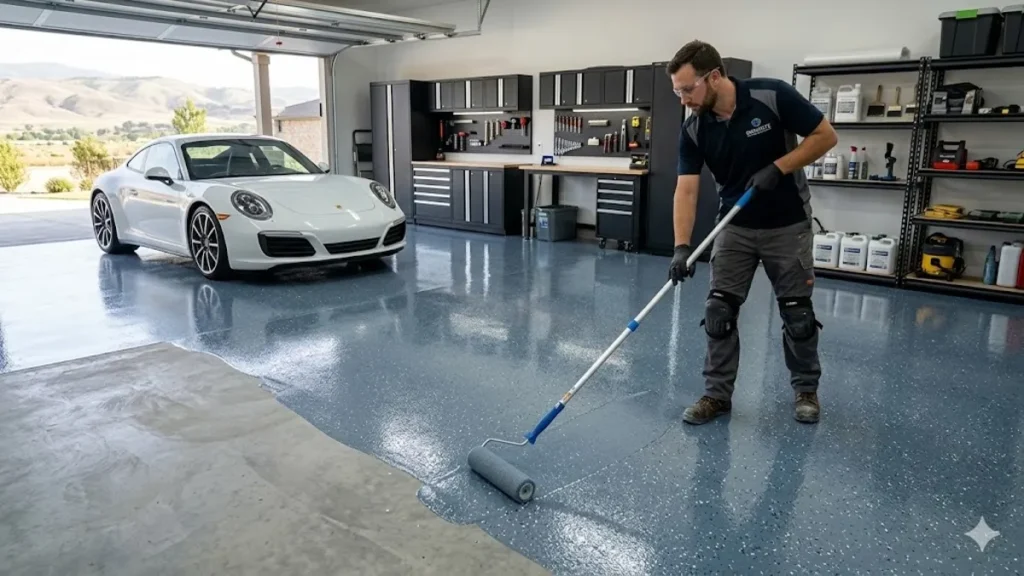

I remember the first time I walked into a garage with a professionally applied epoxy floor. Instead of the dusty gray concrete typical of residential garages, the surface gleamed with a glossy finish that looked more like a showroom than a storage space. That moment captured why garage floor epoxy has become one of the most popular upgrades in modern home improvement. Homeowners searching for information about garage floor epoxy usually want to know three things: what it is, how it works, and whether it is worth the investment.
Garage floor epoxy is a protective coating applied over concrete surfaces to create a durable, chemically resistant layer. The coating is made by mixing epoxy resin with a hardener, triggering a chemical reaction that forms a rigid plastic-like surface once cured. This coating bonds tightly with concrete, protecting it from oil spills, moisture penetration, road salts, and heavy vehicle traffic. According to materials engineering research, epoxy coatings are widely used in industrial environments because of their strength and resistance to abrasion.
In residential garages, epoxy flooring serves both functional and aesthetic purposes. It protects concrete from deterioration while transforming the space visually through glossy finishes, decorative flakes, or metallic pigments. The garage itself has evolved from a purely utilitarian structure into a multipurpose area used for workshops, storage, and even home gyms. As a result, homeowners increasingly seek flooring solutions that combine durability with design.
Epoxy flooring offers a practical answer. By sealing porous concrete and reinforcing its surface, the coating extends the lifespan of the garage floor while dramatically improving its appearance.
Understanding the Chemistry of Epoxy Coatings
At its core, epoxy flooring is a chemical system composed of two primary components: epoxy resin and a curing agent, often called a hardener. When these components are combined, a chemical reaction known as polymerization begins. The molecules link together to form a cross-linked polymer network that hardens into a strong, rigid surface.
Epoxy resins were first developed in the 1930s by chemists Paul Schlack in Germany and Pierre Castan in Switzerland. Their work led to the creation of materials capable of forming exceptionally durable bonds with various surfaces, including metals and concrete. Since then, epoxy has become widely used in industrial coatings, adhesives, electronics, and construction.
Materials scientist Dr. Christopher White, who studies polymer durability, explains the importance of epoxy chemistry:
“The strength of epoxy coatings comes from their cross-linked molecular structure, which creates a highly stable and resistant material.”
When applied to concrete floors, the epoxy mixture penetrates microscopic pores in the surface. As the coating cures, it forms a tightly bonded protective layer that resists chemicals, abrasions, and moisture intrusion.
This chemical bonding distinguishes epoxy from ordinary paint. Paint sits on top of the surface, while epoxy becomes part of the concrete structure itself.
Why Concrete Garage Floors Need Protection
Concrete is often perceived as an indestructible material, but in reality it is highly porous and vulnerable to several forms of deterioration. Garage floors are particularly exposed to harsh conditions.
Vehicles bring moisture, dirt, and road salts into garages. Oil leaks and automotive fluids can stain the surface permanently. Seasonal freeze-thaw cycles may also cause cracking or surface spalling.
The U.S. Department of Transportation has documented how deicing salts accelerate concrete deterioration by allowing moisture to penetrate deeper into the material. Once water enters these pores and freezes, it expands, weakening the concrete structure.
Applying epoxy coating helps mitigate these risks by sealing the surface.
Common Garage Floor Damage Without Coatings
| Damage Type | Cause | Effect on Concrete |
|---|---|---|
| Oil staining | Vehicle leaks | Permanent discoloration |
| Moisture penetration | Rain or snow | Surface cracking |
| Salt corrosion | Winter road salts | Structural deterioration |
| Abrasion | Tire friction | Surface dusting |
By forming an impermeable barrier, epoxy prevents liquids from soaking into concrete and reduces mechanical wear.
The Evolution of Epoxy Flooring in Residential Spaces
For decades, epoxy flooring was primarily associated with industrial facilities such as factories, warehouses, and laboratories. These environments demanded surfaces that could withstand heavy machinery, chemical spills, and constant foot traffic.
Over time, improvements in decorative techniques and consumer awareness brought epoxy flooring into residential settings. Home improvement television shows and DIY renovation platforms played a major role in popularizing the look of glossy garage floors.
The rise of home workshops and enthusiast garages further accelerated demand. Automotive collectors and hobbyists began installing epoxy floors to create clean, showroom-style spaces.
Interior designer Nate Berkus once remarked in a home renovation interview:
“People increasingly view garages as extensions of the home rather than purely functional storage spaces.”
This shift in perception has helped epoxy flooring transition from industrial utility to residential design feature.
Types of Garage Floor Epoxy Systems
Not all epoxy flooring systems are identical. Manufacturers produce several variations tailored to different performance needs and aesthetic preferences.
Common Epoxy Flooring Systems
| System Type | Characteristics | Typical Use |
|---|---|---|
| Water-based epoxy | Thin coating, easier application | Light residential use |
| Solvent-based epoxy | Strong adhesion, durable | Professional installations |
| 100% solids epoxy | Thickest and most durable | Industrial and premium residential floors |
| Decorative flake epoxy | Includes colored flakes | Aesthetic residential garages |
Water-based epoxies are often sold as DIY kits because they emit fewer fumes and are easier to apply. However, they generally produce thinner coatings.
Professional contractors frequently use 100 percent solids epoxy, which contains no solvents and forms a thicker, stronger surface.
Decorative flakes or metallic pigments can be embedded into epoxy to create textured, multicolored designs.
The Installation Process
Installing garage floor epoxy requires careful surface preparation. Professionals often emphasize that preparation is the most critical stage of the process.
The installation typically includes several steps:
- Concrete cleaning and degreasing
- Mechanical grinding or acid etching
- Crack repair
- Primer application
- Epoxy coating
- Optional decorative flakes or topcoat
Mechanical grinding removes contaminants and opens pores in the concrete surface, allowing epoxy to penetrate effectively.
According to flooring expert Howard Kanare of the Portland Cement Association:
“Surface preparation determines whether an epoxy coating will succeed or fail.”
Without proper preparation, coatings may peel or bubble.
The curing process usually requires 24 to 72 hours before vehicles can return to the garage.
Advantages of Epoxy Garage Floors
Epoxy coatings provide several benefits that make them attractive for homeowners.
First, durability is a major advantage. Epoxy floors resist heavy loads, abrasion, and chemical exposure. Second, the coating creates a seamless surface that is easy to clean.
Third, epoxy improves lighting conditions by reflecting light. This can make garages appear brighter and more organized.
Key Benefits of Epoxy Garage Floors
| Benefit | Explanation |
|---|---|
| Durability | Resistant to heavy vehicles and impact |
| Chemical resistance | Protects against oil and fuel spills |
| Easy maintenance | Smooth surface simplifies cleaning |
| Visual appeal | Glossy finish enhances appearance |
Because epoxy seals the concrete, it also reduces dust generated by deteriorating surfaces.
Maintenance and Longevity
One of the reasons epoxy flooring has become so popular is its relatively low maintenance requirements. Once installed properly, the surface typically requires only basic cleaning.
Regular maintenance usually involves sweeping debris and occasionally mopping with mild detergent. Harsh chemicals should generally be avoided unless the coating is specifically designed for industrial environments.
Well-installed epoxy floors can last 10 to 20 years in residential garages. Longevity depends on several factors, including traffic levels, installation quality, and environmental conditions.
Flooring consultant Bob Vila has often noted that coatings last longer when applied professionally rather than through quick DIY kits.
Even so, small repairs or re-coating can extend the lifespan of older epoxy floors.
Environmental and Safety Considerations
Although epoxy coatings offer many benefits, they also raise environmental and safety considerations. Traditional solvent-based epoxies release volatile organic compounds (VOCs) during installation.
These emissions can contribute to indoor air pollution if ventilation is inadequate.
To address these concerns, many manufacturers now produce low-VOC or water-based epoxy products. These formulations reduce harmful emissions while still providing protective coatings.
Slip resistance is another important safety factor. High-gloss epoxy floors can become slippery when wet.
Contractors often incorporate anti-slip additives such as silica sand or decorative flakes to improve traction.
Takeaways
- Garage floor epoxy is a durable coating created by combining epoxy resin and a hardener.
- The material forms a strong chemical bond with concrete surfaces.
- Epoxy flooring protects garage floors from stains, moisture, and abrasion.
- Proper surface preparation is essential for successful installation.
- Decorative flakes and pigments allow customization of appearance.
- Epoxy floors require minimal maintenance and can last many years.
- Environmental considerations have led to low-VOC epoxy formulations.
Conclusion
Garage floor epoxy illustrates how a material originally developed for industrial applications can reshape everyday living spaces. By combining chemical durability with aesthetic flexibility, epoxy coatings offer homeowners a practical way to protect and upgrade one of the most heavily used areas of the home.
The transformation is both functional and symbolic. A garage floor once associated with stains, cracks, and dust becomes a polished surface capable of supporting workshops, home gyms, and automotive projects. The improvement is not merely cosmetic. It reflects a broader trend in home design, where previously overlooked spaces are reimagined as integral parts of the household environment.
As building materials continue to evolve, epoxy flooring will likely remain a popular choice for homeowners seeking durability and design in equal measure. Its strength lies not only in its chemical composition but also in its ability to redefine how we think about ordinary spaces.
In the end, a garage floor may seem like a small detail in the architecture of a home. Yet when protected by epoxy, it becomes a reminder that even the most utilitarian surfaces can benefit from thoughtful design and resilient materials.
Click Here to Read More Blogs!
FAQs
What is garage floor epoxy?
Garage floor epoxy is a protective coating made from epoxy resin and hardener that creates a durable surface over concrete floors.
How long does epoxy flooring last?
Properly installed epoxy floors can last between 10 and 20 years depending on usage and maintenance.
Can epoxy floors handle heavy vehicles?
Yes. Epoxy coatings are designed to withstand heavy loads and tire friction from vehicles.
Is epoxy flooring slippery?
High-gloss epoxy can become slippery when wet, but anti-slip additives can improve traction.
Can homeowners install epoxy themselves?
DIY kits exist, but professional installation usually produces thicker coatings and longer-lasting results.