
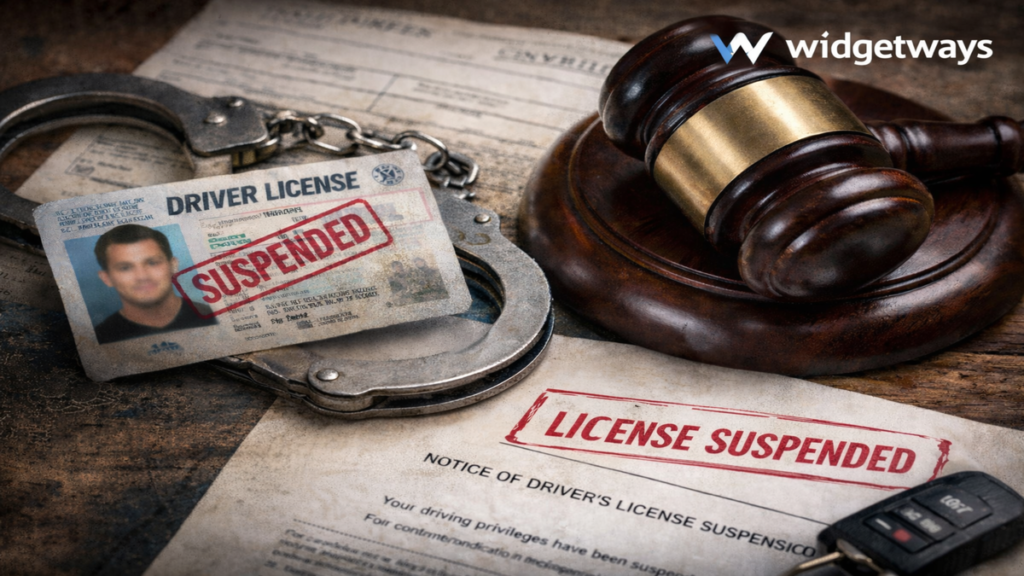

For many people, the ability to drive is more than a convenience. It is a lifeline to work, family, education, and basic daily life. When a government suspends a driver’s license, it temporarily removes that privilege, usually because the driver violated traffic laws, accumulated too many infractions, or failed to meet legal obligations. The consequences can be immediate and far-reaching.
I often find that people searching for information about driver’s license suspension want one clear answer: why licenses get suspended and what happens afterward. In most legal systems, a suspension means the state temporarily revokes a person’s legal authority to drive. During that period, driving is illegal and can result in further penalties, including fines or jail time. Some suspensions are fixed for a specific period, while others remain in place until certain requirements are met.
The reasons behind suspensions vary widely. Dangerous behaviors such as driving under the influence or reckless driving have long been recognized as public safety threats. Yet millions of suspensions are imposed for non-driving reasons like unpaid fines, missed court appearances, or overdue child support.
The debate surrounding these laws has grown more intense in recent years. Advocates argue that suspensions are essential to road safety and accountability. Critics say they often trap people in cycles of debt and unemployment.
Understanding how license suspensions work requires looking beyond traffic tickets and courtrooms. It reveals how transportation, law enforcement, public safety, and social equity intersect on roads that millions rely on every day.
The Legal Meaning of a Driver’s License Suspension
A driver’s license suspension is a legal penalty that temporarily removes an individual’s authority to operate a motor vehicle. Governments treat driving as a regulated privilege rather than an absolute right. As a result, states or national authorities can restrict that privilege when a driver violates laws or fails to meet legal obligations.
I see suspension systems functioning as both punishment and prevention. By taking away the ability to drive, authorities aim to stop unsafe drivers from causing harm while also discouraging others from similar behavior.
Suspensions typically fall into two categories: definite and indefinite. A definite suspension lasts for a predetermined period, such as 30 days or one year. Once the time expires and conditions are met, the driver may apply for reinstatement. Indefinite suspensions, by contrast, remain active until the driver fulfills specific requirements like paying fines or appearing in court.
The legal authority for suspensions often resides with departments of motor vehicles or similar agencies. Courts can also order suspensions following criminal convictions. These administrative and judicial processes together form the backbone of modern traffic enforcement systems.
Research from the National Highway Traffic Safety Administration shows that suspensions remain one of the most effective administrative measures for controlling dangerous drivers, particularly those convicted of impaired driving.
Read: Uber Backup Driver Liability Causes Accident Explained
The Most Common Reasons Licenses Are Suspended
Driver’s license suspensions arise from a wide range of behaviors, some directly related to driving and others tied to broader legal responsibilities.
In my reporting on transportation law, I frequently encounter a striking pattern: not all suspensions stem from unsafe driving. Many originate from administrative or financial issues.
Table: Common Causes of Driver’s License Suspension
| Category | Example Violations | Typical Consequences |
|---|---|---|
| Dangerous Driving | DUI, reckless driving, street racing | Immediate suspension or revocation |
| Traffic Violations | Accumulating points from speeding or red-light violations | Temporary suspension |
| Administrative Issues | Failure to appear in court, expired insurance | Indefinite suspension until resolved |
| Financial Obligations | Unpaid fines, court fees, child support | Suspension until payment |
| Legal Offenses | Drug-related convictions, leaving accident scene | Long-term suspension or revocation |
Driving under the influence is one of the most common triggers for suspension. In many jurisdictions, drivers arrested with blood alcohol levels above legal limits face immediate administrative license revocation.
Other common reasons include excessive traffic violations, driving without insurance, or leaving the scene of an accident.
Failure to meet non-driving obligations can also lead to suspension. Falling behind on child support payments, ignoring court summons, or failing to pay fines can trigger automatic penalties that restrict driving privileges.
Dr. John Fell, a traffic safety researcher, once noted, “License suspension is a swift sanction that reinforces the seriousness of impaired driving and other dangerous behaviors.”
The Surprising Role of Non-Driving Offenses
One of the most controversial aspects of license suspension laws involves penalties unrelated to driving behavior.
In my analysis of policy debates, this issue appears repeatedly: a large share of suspended drivers did not lose their licenses because they drove dangerously.
Studies suggest that as many as 80 percent of suspensions in some regions stem from non-driving-related offenses such as unpaid fines or missed court appearances.
National policy data shows that roughly 11 million people in the United States have experienced license suspensions for debt-related reasons alone.
Advocates argue that these penalties undermine economic stability. Losing the ability to drive can make commuting to work impossible in areas without reliable public transportation.
Alexes Harris, a sociologist studying fines and fees, has argued that “financial penalties attached to license suspensions often create cycles of punishment that disproportionately affect low-income communities.”
Critics say the system effectively criminalizes poverty. Supporters, however, maintain that legal obligations must be enforced, and license suspension provides a powerful compliance mechanism.
How License Suspension Policies Differ Across Regions
Although the concept of suspension exists worldwide, the specific rules vary widely across jurisdictions. Differences in laws, penalties, and enforcement approaches reflect distinct legal traditions and public policy priorities.
In some countries, suspension periods are fixed and standardized. In others, judges have broad discretion to determine the length of penalties.
Table: Examples of License Suspension Triggers by Jurisdiction
| Jurisdiction | Key Suspension Triggers | Notable Policy Features |
|---|---|---|
| United States | DUI, point accumulation, unpaid fines | States control licensing laws |
| United Kingdom | Driving offenses, excessive penalty points | Disqualification through courts |
| Canada | Impaired driving, repeated violations | Provincial enforcement |
| Australia | Speeding points, alcohol violations | Demerit point systems |
| Germany | Criminal driving offenses | Strict rehabilitation requirements |
The United States stands out for the breadth of suspension triggers, including many administrative and financial issues unrelated to road safety.
By contrast, some European systems focus more narrowly on dangerous driving behaviors. Germany, for example, often requires medical or psychological evaluations before reinstating licenses after serious offenses.
Policy reforms have begun emerging in some states and countries. Ohio, for example, eliminated certain debt-based suspensions in 2025, restoring driving privileges for hundreds of thousands of drivers.
The Economic Consequences of Losing a License
Losing a driver’s license can dramatically reshape a person’s economic life.
In many parts of the world, particularly in suburban and rural areas, cars are essential for employment. Without legal driving privileges, commuting can become nearly impossible.
Government studies indicate that license suspensions often reduce job opportunities and increase financial hardship. The inability to drive can make it harder to attend job interviews, maintain employment, or access healthcare and education.
I have spoken with transportation researchers who describe the problem as a “mobility crisis.” When driving privileges disappear, individuals often face cascading consequences: job loss, reduced income, and increased reliance on public assistance.
Professor Sarah Seo, a legal historian studying transportation law, once explained that “the legal framework governing driving has become one of the most expansive systems of regulation in modern life.”
For millions of people, the stakes are not simply about driving. They involve the ability to maintain stability in daily life.
Public Safety and the Argument for Strict Enforcement
Despite the criticisms, many policymakers defend license suspension laws as a necessary tool for protecting the public.
Traffic safety research consistently links suspended or revoked licenses to risky driving behavior. Studies analyzing fatal crash data show that drivers with invalid licenses are disproportionately represented in serious accidents.
Supporters of strict enforcement argue that removing unsafe drivers from the road saves lives.
Law enforcement officials often emphasize that license suspensions serve as a deterrent. When drivers know that reckless behavior could result in losing their driving privileges, they may be more likely to follow traffic laws.
According to highway safety researchers, administrative license suspension laws for impaired driving significantly reduce alcohol-related crashes by quickly removing intoxicated drivers from the road.
The central policy challenge lies in balancing safety and fairness. Authorities must determine which behaviors truly threaten public safety and which penalties may create unnecessary hardship.
The Path to Reinstating a Suspended License
Reinstating a suspended driver’s license usually requires completing a series of steps designed to address the original violation.
The process varies by jurisdiction but often includes:
- Paying outstanding fines or fees
- Completing mandatory waiting periods
- Attending traffic safety or alcohol education programs
- Providing proof of insurance
- Passing driving tests or medical evaluations
In many places, drivers must also pay reinstatement fees before their licenses become valid again.
One surprising statistic in traffic safety research involves delayed reinstatement. Studies show that many drivers eligible to restore their licenses wait months or even years before doing so, sometimes because they cannot afford the costs or paperwork involved.
For policymakers, this raises a difficult question: should reinstatement processes be simplified to encourage legal driving, or should strict requirements remain in place to reinforce accountability?
Takeaways
- A driver’s license suspension temporarily removes a person’s legal right to drive.
- Suspensions can result from dangerous driving, administrative issues, or financial obligations.
- Millions of drivers have lost licenses due to unpaid fines or court fees rather than safety violations.
- Losing a license can significantly affect employment and daily mobility.
- Suspension laws aim to deter risky behavior and improve road safety.
- Reforms in some regions are limiting suspensions for non-driving-related offenses.
Conclusion
Driver’s license suspension laws reveal a deeper tension within modern legal systems. Governments must balance two competing goals: protecting public safety and ensuring fair treatment under the law.
On one hand, removing dangerous drivers from the road has proven to be a powerful safety measure. The threat of losing driving privileges can deter reckless behavior and reduce alcohol-related crashes.
On the other hand, suspending licenses for administrative or financial reasons raises difficult questions about equity and practicality. When millions of people lose their ability to drive over unpaid fines or missed court dates, the punishment can extend far beyond the original offense.
I often think about how deeply modern societies rely on mobility. In many regions, driving is not simply a convenience but an essential part of daily survival.
As policymakers continue debating reforms, the future of license suspension laws may hinge on one central idea: targeting penalties toward behaviors that truly threaten public safety while avoiding consequences that unnecessarily disrupt lives.
FAQs
What does a driver’s license suspension mean?
A suspension temporarily removes your legal ability to drive. During the suspension period, operating a vehicle is illegal and may lead to additional penalties or criminal charges.
How long do license suspensions usually last?
The length varies widely depending on the violation and jurisdiction. Some suspensions last 30–90 days, while others remain active until fines are paid or legal requirements are met.
Can you drive with a suspended license?
No. Driving while your license is suspended is illegal in most jurisdictions and may lead to fines, extended suspension periods, or jail time.
What are the most common reasons licenses are suspended?
Common reasons include DUI offenses, accumulating too many traffic violations, driving without insurance, failing to appear in court, and unpaid fines or child support obligations.
How can someone reinstate a suspended license?
Drivers usually must pay outstanding fines, complete required programs, provide proof of insurance, and pay reinstatement fees before their driving privileges are restored.
References
Fell, J. C., Tippetts, A. S., & McKnight, A. S. (2017). Administrative license revocation laws and their impact on impaired driving. National Highway Traffic Safety Administration. https://pmc.ncbi.nlm.nih.gov/articles/PMC6133240/
Joyce, N. R., et al. (2020). Individual and geographic variation in driver’s license suspension. American Journal of Public Health. https://pmc.ncbi.nlm.nih.gov/articles/PMC7500576/
National Conference of State Legislatures. (2024). State approaches to addressing debt-based driver’s license suspensions. https://www.ncsl.org/civil-and-criminal-justice/road-to-reform-state-approaches-to-addressing-debt-based-drivers-license-suspensions
National Highway Traffic Safety Administration. (2009). Reasons for driver license suspension, recidivism, and crash involvement among drivers with suspended or revoked licenses. https://www.nhtsa.gov/sites/nhtsa.gov/files/documents/811092_driver-license.pdf
U.S. Department of Health and Human Services. (2022). Challenges to employment: Fines, fees, and license suspensions. https://acf.gov/opre/report/challenges-employment-fines-fees-license-suspensions
Vera Institute of Justice. (2022). Driver’s license suspensions for unpaid debt: Punishing poverty. https://www.vera.org/news/drivers-license-suspensions-for-unpaid-debt
New York State Department of Motor Vehicles. (2024). Suspensions and revocations. https://dmv.ny.gov/points-and-penalties/suspensions-and-revocations