
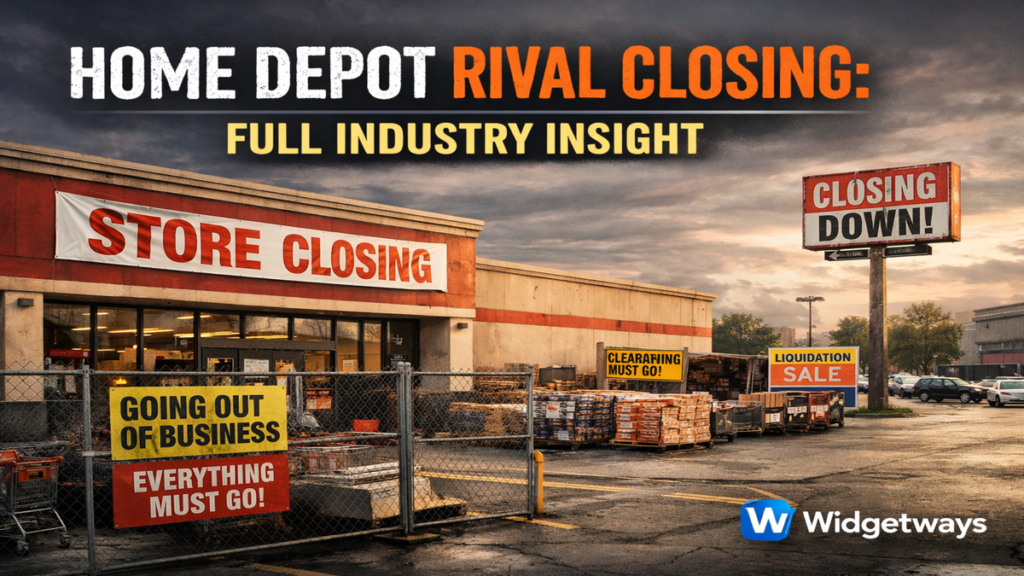

I begin with the question that draws attention to this topic: why are rivals to The Home Depot closing stores, and what does it mean for the broader retail landscape? The answer lies in a combination of economic pressure, shifting consumer habits, and the increasing dominance of large-scale corporations. When smaller or specialized home improvement retailers begin to shut down locations, it is rarely an isolated event. Instead, it reflects deeper structural changes in how goods are produced, distributed, and consumed.
The closure of competitors, including chains like LL Flooring and various regional businesses, signals a transition in the home improvement sector. While these companies once thrived by offering niche products or localized service, they now face challenges that extend beyond simple competition. Rising operational costs, technological demands, and evolving customer expectations have created an environment where scale and adaptability determine survival.
For consumers, these closures raise immediate concerns about access, pricing, and choice. For employees and communities, the impact is more personal, affecting livelihoods and local economies. And for the industry as a whole, the trend points toward consolidation, where fewer but larger players dominate the market.
Understanding this shift requires looking beyond individual closures to examine the forces shaping the future of retail. It is a story not just about stores closing, but about an entire industry redefining itself.
The Economic Forces Reshaping Retail
I see the closure of Home Depot rivals as closely tied to broader economic conditions that have intensified over the past decade. Inflation, supply chain disruptions, and rising labor costs have collectively strained retailers across sectors, but the impact is particularly acute in home improvement, where margins can already be thin.
The cost of raw materials, including lumber, metals, and manufactured goods, has fluctuated significantly in recent years. These fluctuations create uncertainty for retailers, who must balance pricing strategies with consumer expectations. Larger companies like Home Depot can absorb these fluctuations more effectively due to their scale, negotiating power, and diversified supply chains. Smaller competitors, by contrast, often operate with tighter margins and less flexibility.
At the same time, transportation and logistics costs have increased, especially during periods of global disruption. Shipping delays and shortages have affected inventory availability, leading to empty shelves and dissatisfied customers. In an industry where timing is critical, particularly for construction and renovation projects, these disruptions can quickly erode customer trust.
Economic analysts have noted that retail sectors tied to housing are particularly sensitive to macroeconomic trends. When interest rates rise and housing activity slows, demand for home improvement products declines. This creates a cascading effect, where reduced sales lead to cost-cutting measures, including store closures.
Housing Market Dynamics and Their Impact
The connection between home improvement retail and the housing market is both direct and profound. I find that when people buy homes, they invest in them, renovating kitchens, updating flooring, and repairing structural elements. This relationship has historically driven growth in the sector, particularly during periods of strong housing activity.
However, recent years have seen a shift. Rising mortgage rates have reduced the number of home purchases, leading to fewer renovation projects. Homeowners who might otherwise upgrade or remodel are choosing to delay those decisions, either due to financial uncertainty or the high cost of borrowing.
This slowdown has had a measurable impact on retailers. Sales volumes decline, inventory turnover slows, and profit margins shrink. For large companies, these challenges are manageable through diversification and scale. For smaller competitors, they can be existential.
Economists at the Harvard Joint Center for Housing Studies have observed that home improvement spending tends to lag behind housing market changes but remains closely correlated over time. This means that even after housing activity begins to recover, retailers may continue to feel the effects of previous downturns.
The result is a prolonged period of adjustment, during which weaker players may exit the market while stronger ones consolidate their positions.
The Rise of Digital Expectations
I recognize that one of the most transformative forces in retail has been the rise of digital technology. Consumers today expect seamless integration between online and offline experiences. They want to check inventory in real time, compare prices instantly, and receive products quickly.
Large retailers have invested heavily in meeting these expectations. Home Depot, for example, has developed sophisticated e-commerce platforms, offering services such as same-day pickup, delivery tracking, and digital project planning tools. These capabilities enhance convenience and reinforce customer loyalty.
Smaller competitors often struggle to keep pace. Developing and maintaining advanced digital systems requires significant investment, both in technology and personnel. Without these systems, retailers risk losing customers who prioritize convenience and efficiency.
This shift has fundamentally changed the nature of competition. It is no longer sufficient to offer quality products at competitive prices. Retailers must also provide a seamless and integrated customer experience.
Industry analysts have emphasized that digital transformation is not optional but essential. Companies that fail to adapt risk becoming obsolete, regardless of their past success or brand recognition.
Consumer Behavior in Transition
I observe that consumer behavior has evolved in ways that directly influence the fate of home improvement retailers. Today’s shoppers are more informed, more selective, and more focused on value than ever before. They compare prices across multiple platforms, read reviews, and seek out the most convenient purchasing options.
At the same time, there is a growing preference for one-stop shopping. Large retailers that offer a wide range of products, from tools to appliances to décor, are better positioned to meet this demand. Smaller competitors that specialize in specific categories may struggle to attract customers who prefer the efficiency of a single destination.
Another important factor is the rise of do-it-yourself culture, particularly during periods of economic uncertainty. While this trend can benefit home improvement retailers, it also shifts demand toward certain types of products and services. Retailers must adapt their offerings to align with these changes, which can be challenging for smaller businesses with limited resources.
Consumer expectations around speed and reliability have also increased. Delays in delivery or inconsistencies in product availability can quickly drive customers to competitors. In this environment, consistency becomes as important as quality.
The Human and Community Impact
I find that the closure of a retail store is never just a business decision. It is a community event with far-reaching consequences. Employees lose jobs, local economies lose activity, and neighborhoods lose spaces that once served as hubs of interaction.
Retail jobs often provide stable employment for a diverse workforce, including individuals without advanced education or specialized training. When stores close, these workers may face significant challenges in finding comparable employment, particularly in areas with limited economic opportunities.
The impact extends beyond employees. Local businesses that rely on foot traffic generated by retail stores may experience declines in sales. Shopping centers and commercial districts can become less vibrant, affecting the overall economic health of the area.
Socially, the loss of a familiar store can alter the character of a community. Retail spaces are not only places of commerce but also places of connection, where people interact, share experiences, and build relationships.
Economic studies have shown that retail closures can create ripple effects, influencing employment, property values, and consumer behavior. These effects highlight the interconnected nature of local economies and the importance of sustainable business practices.
Industry Consolidation and Future Trends
The trend toward consolidation in the home improvement sector is likely to continue. I see a future where a smaller number of large players dominate the market, leveraging their scale, technology, and resources to maintain competitive advantage.
This consolidation may bring certain benefits, including lower prices and improved efficiency. However, it also raises concerns about reduced competition and limited consumer choice. As smaller competitors exit the market, the diversity of offerings may decline, potentially affecting innovation and service quality.
At the same time, new business models may emerge. Niche retailers that focus on specialized products or personalized service may find opportunities in areas where large chains are less effective. Similarly, online platforms and direct-to-consumer brands may continue to disrupt traditional retail structures.
The role of technology will be central to these developments. Advances in data analytics, artificial intelligence, and supply chain management will shape how retailers operate and compete. Companies that successfully integrate these technologies will be better positioned to navigate future challenges.
Takeaways
The closure of Home Depot rivals reflects a convergence of economic, technological, and behavioral factors that are reshaping the retail landscape. Rising costs and housing market fluctuations have placed pressure on smaller retailers, while digital transformation has raised the bar for customer experience. Consumer behavior continues to evolve, favoring convenience, value, and reliability. The human impact of store closures underscores the broader اجتماعی implications of these changes. As the industry consolidates, the balance between efficiency and diversity will become increasingly important.
Conclusion
I see the story of Home Depot rival closures as part of a larger narrative about change and adaptation. It is not simply about businesses failing but about an industry evolving in response to new realities. The forces driving this evolution, economic pressure, technological advancement, and shifting consumer expectations, are unlikely to reverse.
For consumers, the future may offer greater convenience but fewer choices. For workers and communities, the challenge will be navigating the economic and social impacts of these changes. For businesses, success will depend on the ability to adapt, innovate, and anticipate the needs of a rapidly changing market.
The home improvement sector will continue to play a vital role in the economy, supporting construction, renovation, and everyday maintenance. The question is not whether it will survive, but how it will transform. In that transformation lies both opportunity and uncertainty, shaping the next chapter of retail in ways that are still unfolding.
Read: Real Money Slots www.instant1million.com Explained: Risks and Reality
FAQs
Why are Home Depot rivals closing stores?
They face rising costs, strong competition from large retailers, and changing consumer expectations that favor digital convenience and scale.
Does this affect product prices?
In some cases, reduced competition may influence pricing, though large retailers often maintain competitive pricing due to scale.
Are smaller retailers disappearing completely?
Not entirely. Some adapt by focusing on niche markets or specialized services.
How does the housing market impact these closures?
A slowdown in housing reduces demand for renovation products, directly affecting retailer sales.
What is the future of home improvement retail?
The industry is likely to become more consolidated, with increased emphasis on technology and integrated customer experiences.
References
Economic Policy Institute. (2021). Retail employment trends. Retrieved from https://www.epi.org/
Harvard Joint Center for Housing Studies. (2022). Improving America’s housing. Retrieved from https://www.jchs.harvard.edu/
IBISWorld. (2023). Home improvement stores industry report. Retrieved from https://www.ibisworld.com/
National Retail Federation. (2023). Retail trends and outlook. Retrieved from https://nrf.com/
Dietz, R. (2022). Housing market trends. National Association of Home Builders. Retrieved from https://www.nahb.org/
Saunders, N. (2023). Retail analysis reports. GlobalData. Retrieved from https://www.globaldata.com/