
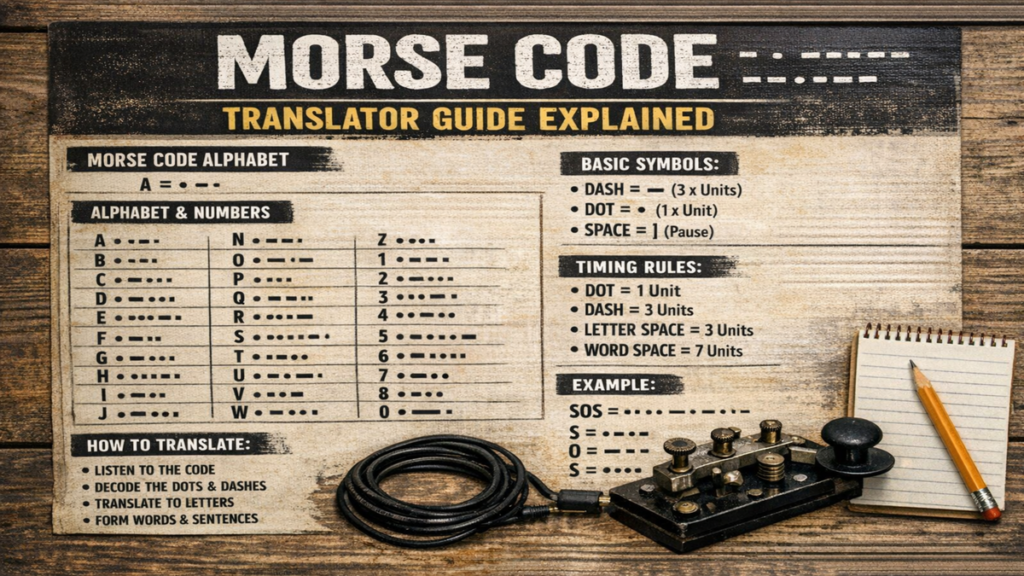

I have always found Morse code fascinating because it represents one of the earliest attempts to turn human language into a system machines could understand. At its simplest, a Morse code translator converts text into sequences of dots and dashes, or translates those signals back into readable language. Today, these translators exist as apps, websites, and embedded tools in communication systems, allowing anyone to encode or decode messages instantly.
Within the first moments of understanding Morse code translators, the purpose becomes clear. They bridge the gap between human language and signal-based communication. Whether used for learning, emergency signaling, or historical curiosity, these tools transform letters into timed pulses of sound, light, or electrical signals. Modern translators automate what once required years of training, making the system accessible to a global audience.
Yet Morse code is not merely a relic. It remains relevant in aviation, amateur radio, and survival contexts. Its simplicity and resilience allow it to function even when modern communication systems fail. Translators, therefore, are not just conveniences. They are gateways to a language that has endured wars, technological revolutions, and the rise of the internet.
This article explores how Morse code translators work, how they evolved, and why they still matter in a world dominated by instant messaging and artificial intelligence.
The Origins of Morse Code and Its Translation
Morse code emerged in the 1830s and 1840s as part of the development of the electric telegraph, pioneered by Samuel Morse and Alfred Vail. The system assigned combinations of short and long signals, dots and dashes, to letters and numbers. Early translators were not machines but human operators who learned to encode and decode messages by ear and rhythm.
The first successful telegraph message, sent in 1844 between Washington, D.C., and Baltimore, read, “What hath God wrought.” This moment marked the beginning of long-distance electronic communication. Translating Morse code required skill, concentration, and speed. Operators became highly trained professionals capable of interpreting messages in real time.
Over time, standardized versions of Morse code were developed, including International Morse Code in the late 19th century. This version simplified and unified the system for global use, particularly in maritime and aviation contexts.
Historian Tom Standage notes, “The telegraph shrank the world faster than any previous invention” (Standage, 1998). Morse code translators, even in their earliest human form, played a central role in that transformation, enabling communication across vast distances with unprecedented speed.
How Morse Code Translators Work Today
Modern Morse code translators rely on algorithms that map characters to predefined dot and dash sequences. When a user inputs text, the system converts each letter into its corresponding pattern. Conversely, when receiving Morse signals, the translator interprets timing and spacing to reconstruct the original message.
The process depends heavily on timing rules. A dot represents a short signal, while a dash is typically three times longer. Spaces between signals indicate separations between letters and words. Translators must accurately interpret these intervals to ensure correct decoding.
Digital tools have simplified this process significantly. Many online platforms allow users to input text and instantly hear the corresponding Morse code as audio. Others can interpret sound or light signals captured through microphones or cameras.
According to the International Telecommunication Union, Morse code remains part of standardized communication protocols, particularly in specialized fields (ITU, 2009). This continued relevance ensures that translators are not merely educational tools but functional components of communication systems.
Comparing Traditional and Modern Morse Code Translation
The transformation from manual decoding to automated translation highlights a significant technological shift. The table below illustrates this evolution:
| Feature | Traditional Translation | Modern Digital Translation |
|---|---|---|
| Method | Human interpretation | Algorithmic processing |
| Speed | Limited by skill | Instantaneous |
| Accuracy | Variable | High consistency |
| Training Required | Extensive | Minimal |
| Accessibility | Restricted | Widely available |
| Medium | Sound, light, paper | Apps, software, devices |
This shift has democratized access to Morse code. What once required years of practice can now be achieved in seconds. However, some experts argue that automation risks losing the human element that once defined Morse communication.
As communications researcher Donald Murray observed, “Technology extends human capability, but it also changes the nature of skill itself” (Murray, 2003). In the case of Morse code, translators have made the system more accessible while transforming how it is learned and used.
Applications in Emergency and Survival Situations
One of the most enduring uses of Morse code translators lies in emergency communication. The SOS signal, represented as three dots, three dashes, and three dots, is universally recognized and can be transmitted through sound, light, or movement.
In situations where modern communication tools fail, Morse code offers a reliable alternative. Survivors have used flashlights, mirrors, and even tapping sounds to send distress signals. Translators, particularly mobile apps, help users generate and interpret these signals quickly.
The United States Coast Guard continues to recognize Morse code as a viable backup communication method. Its simplicity ensures that it can function without complex infrastructure.
Emergency preparedness expert John R. Cash emphasizes, “Redundancy in communication systems is critical, and Morse code remains one of the simplest fallback options available” (Cash, 2016). Translators enhance this redundancy by making the system accessible to non-experts.
In disaster scenarios, where power and connectivity are compromised, the ability to encode and decode Morse signals can mean the difference between isolation and rescue.
Morse Code in Aviation and Maritime Communication
Despite the dominance of digital communication systems, Morse code retains a presence in aviation and maritime contexts. Navigational beacons, for example, often transmit identifiers in Morse code, allowing pilots to verify their location.
Maritime communication historically relied heavily on Morse code, particularly before the widespread adoption of radio voice transmission. Even today, knowledge of Morse code can provide an additional layer of safety.
The International Maritime Organization has acknowledged the historical importance of Morse code while transitioning to modern systems. However, its legacy persists in training and emergency protocols.
Aviation historian Richard Smith notes, “Morse code provided a universal language for pilots navigating unfamiliar territories” (Smith, 2012). Translators now allow modern users to interpret these signals without specialized training.
This enduring presence highlights the resilience of Morse code as a communication system that transcends technological change.
The Role of Morse Code in Amateur Radio
Amateur radio operators, often referred to as “ham” radio enthusiasts, continue to use Morse code extensively. Known as continuous wave (CW) communication, Morse code offers advantages such as low bandwidth usage and long-distance transmission capability.
For many operators, Morse code is not just a tool but a tradition. It represents a connection to the history of communication and a demonstration of skill.
Modern translators have introduced new participants to this field by lowering the barrier to entry. Beginners can use digital tools to learn and practice Morse code before transitioning to manual operation.
The American Radio Relay League states that Morse code remains one of the most efficient forms of communication in weak signal conditions (ARRL, 2020). Translators support this efficiency by enabling quick encoding and decoding.
This blend of tradition and technology ensures that Morse code continues to thrive within niche communities.
Learning Morse Code in the Digital Age
Learning Morse code has become significantly easier with the advent of digital translators. Educational apps provide interactive lessons, audio feedback, and real-time translation, allowing users to progress at their own pace.
However, experts emphasize the importance of learning the rhythm rather than memorizing symbols visually. Morse code is fundamentally an auditory language, and proficiency depends on recognizing patterns of sound.
Psychologist K. Anders Ericsson, known for his research on expertise, highlights that deliberate practice is essential for mastering complex skills (Ericsson, 2006). Translators can aid this process, but they cannot replace consistent practice.
Many learners begin with translators but eventually reduce their reliance on them as they develop fluency. This progression mirrors the broader relationship between technology and skill development.
In this way, Morse code translators serve as both entry points and training tools, guiding users from curiosity to competence.
The Evolution of Morse Code Translators Over Time
The development of Morse code translators reflects broader technological trends. The following timeline outlines key milestones:
| Era | Development | Impact |
|---|---|---|
| 1840s | Telegraph operators | Manual translation |
| Early 1900s | Mechanical decoders | Increased efficiency |
| Mid-20th century | Electronic devices | Faster processing |
| 1990s | Computer software | Automated translation |
| 2000s–Present | Mobile apps and web tools | Global accessibility |
Each stage represents a shift toward greater accessibility and efficiency. What began as a specialized skill has become a widely available tool.
Technology historian James Carey observed, “Communication technologies reshape not just how we communicate, but how we understand connection itself” (Carey, 1989). Morse code translators exemplify this transformation, bridging past and present.
Cultural and Symbolic Significance
Beyond its practical applications, Morse code holds cultural and symbolic meaning. It has appeared in literature, film, and art as a representation of hidden communication and resilience.
During World War II, Morse code played a critical role in military operations. Operators transmitted encrypted messages across continents, often under dangerous conditions. Their work demonstrated the power of simple signals to convey complex information.
In contemporary culture, Morse code is sometimes used as a creative medium. Artists incorporate it into music, visual art, and installations, transforming functional signals into expressive forms.
This cultural dimension adds depth to the role of Morse code translators. They are not just tools but gateways to a language that carries historical and emotional weight.
Takeaways
- Morse code translators convert text into dot-and-dash signals and back into readable language
- The system originated in the 19th century and remains relevant in modern communication
- Digital tools have made Morse code accessible to a global audience
- Emergency, aviation, and amateur radio contexts continue to rely on Morse code
- Learning Morse code involves understanding rhythm and timing, not just symbols
- Translators bridge historical communication methods with modern technology
Conclusion
I see Morse code translators as more than simple tools. They represent a bridge between eras, connecting the earliest days of electronic communication with the digital age. While technology has advanced far beyond the telegraph, the principles underlying Morse code remain relevant.
The enduring appeal of Morse code lies in its simplicity and adaptability. It does not require complex infrastructure or advanced devices. A signal, a rhythm, and a shared understanding are enough. Translators amplify this accessibility, allowing anyone to engage with the system instantly.
In a world increasingly defined by complexity, Morse code offers a reminder that effective communication does not always require sophistication. Sometimes, the most powerful messages are conveyed through the simplest means.
As technology continues to evolve, Morse code translators will likely remain a niche but meaningful part of the communication landscape, preserving a legacy that continues to inform how humans connect across distance and time.
Read: Soutaipasu (相対パス): Demystifying Relative Paths for Modern Developers
FAQs
What is a Morse code translator?
A Morse code translator converts text into Morse code signals or decodes Morse signals back into readable text using predefined patterns of dots and dashes.
Is Morse code still used today?
Yes, it is used in aviation, amateur radio, and emergency signaling due to its simplicity and reliability.
Can I learn Morse code using a translator?
Yes, translators are helpful learning tools, but mastering Morse code requires practice in recognizing sound patterns and timing.
What does SOS mean in Morse code?
SOS is represented as three dots, three dashes, and three dots, used internationally as a distress signal.
Are Morse code translators accurate?
Modern digital translators are highly accurate, provided the input signals are clear and correctly timed.
References
American Radio Relay League. (2020). Learning Morse Code. http://www.arrl.org/learning-morse-code
Carey, J. W. (1989). Communication as Culture: Essays on Media and Society. Routledge.
Ericsson, K. A. (2006). The Cambridge Handbook of Expertise and Expert Performance. Cambridge University Press.
International Telecommunication Union. (2009). Recommendation ITU-R M.1677-1: International Morse code. https://www.itu.int
Murray, D. E. (2003). Changing Technologies, Changing Literacy Communities?. Language Learning & Technology, 7(2), 43–58.
Smith, R. K. (2012). An Illustrated Guide to Modern Air Navigation. McGraw-Hill.
Standage, T. (1998). The Victorian Internet. Walker & Company.