
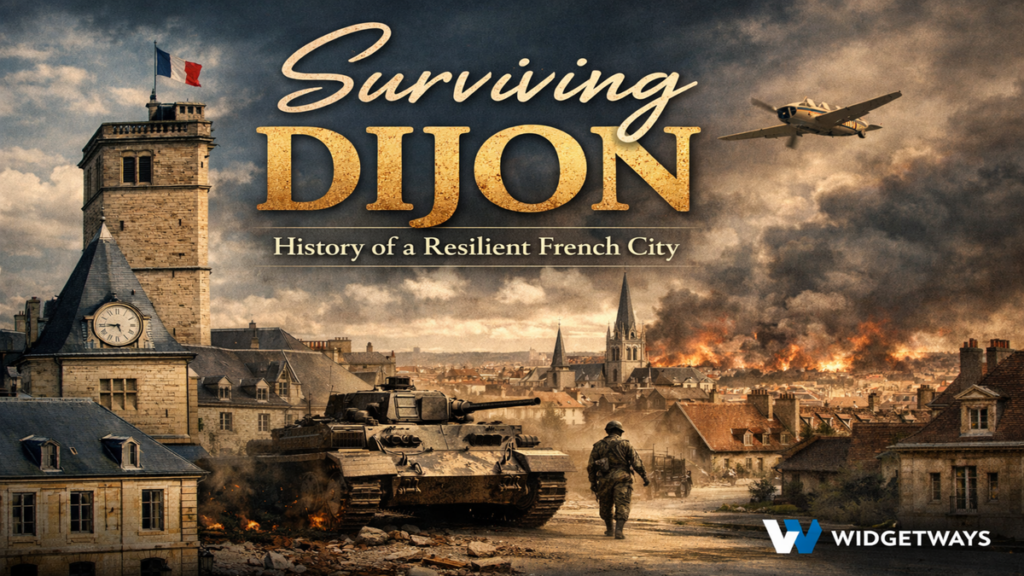

I often think about how cities carry memories the way people do. Streets, buildings, and markets become silent witnesses to the centuries that pass through them. Dijon, the historic capital of the Burgundy region in eastern France, is one such city. Its survival is not defined by a single moment of triumph but by a long sequence of adaptations that allowed the city to endure political upheaval, military occupation, and economic transformation. When examining Dijon’s history, one quickly sees that survival depended on the community’s ability to preserve cultural identity while adjusting to forces beyond its control.
During World War II, Dijon experienced one of the most dramatic tests of its resilience. German forces occupied the city in June 1940 following the collapse of French defenses during the early stages of the war. For four years, life unfolded under strict surveillance and severe restrictions. Curfews were enforced, food was rationed, and local newspapers operated under censorship. Yet despite these pressures, the social structure of the city remained intact. Schools continued teaching, markets functioned with limited goods, and residents quietly helped each other navigate the difficult realities of wartime life.
However, surviving Dijon is a story that stretches far beyond the events of World War II. The city had already endured major historical transformations, including the fall of the powerful Duchy of Burgundy in the late fifteenth century and the political reorganization that followed its integration into the Kingdom of France. Over time, Dijon adapted to new political systems, economic models, and cultural expectations. The ability to adjust while preserving local traditions ultimately shaped the city’s identity and allowed it to remain a vibrant urban center in modern France.
The Medieval Foundations of Dijon’s Resilience
The earliest roots of Dijon’s endurance can be traced back to the Middle Ages when the city became the political and cultural capital of the Duchy of Burgundy. During the fourteenth and fifteenth centuries, the Burgundian court was one of the most powerful and sophisticated in Europe. The dukes of Burgundy invested heavily in architecture, administration, and commerce, transforming Dijon into a prosperous urban center. Palaces, churches, and administrative institutions were constructed to demonstrate the duchy’s wealth and authority.
This period of prosperity created strong civic institutions that would later help the city withstand political upheaval. When Duke Charles the Bold died in battle in 1477, Burgundy’s independence effectively ended. Large portions of the duchy were absorbed into the Kingdom of France. Such a dramatic political shift might have devastated many cities that depended heavily on royal patronage. Dijon, however, possessed a diversified economy built on trade, agriculture, and wine production, which helped stabilize the city during the transition.
Markets and merchant networks continued functioning even as political authority changed. Local governance structures remained active, allowing the city to maintain administrative continuity. In many ways, this early experience demonstrated a pattern that would appear repeatedly throughout Dijon’s history. While political rulers and national systems changed, the city’s social and economic foundations allowed daily life to continue. Over time, Dijon developed a reputation as a stable regional center that balanced tradition with gradual transformation.
Read: Pink Floyd Saunton Beach Photoshoot: A Practical Guide Today
The Shock of World War II
The twentieth century brought one of the most severe challenges Dijon had ever faced. In May 1940, Nazi Germany launched a rapid invasion of France. Within weeks, French defenses collapsed, and German forces advanced across much of the country. Dijon fell under German control in June 1940, becoming part of the occupied zone administered by the German military.
Occupation altered the rhythm of daily life in profound ways. German soldiers were stationed throughout the city, occupying key government buildings and transportation centers. Residents were required to follow strict regulations governing movement and public behavior. Curfews limited nighttime activity, and travel permits were necessary for many forms of transportation. The presence of occupying troops created an atmosphere of constant tension and uncertainty.
Food shortages quickly became one of the most pressing concerns for the population. Ration cards were introduced to distribute limited supplies of bread, meat, sugar, and other essential goods. Many families relied on rural relatives or informal barter systems to supplement their official rations. Markets remained open, but the variety of available products declined dramatically as the war continued.
Despite these hardships, everyday life did not completely collapse. Schools remained open, and cultural institutions attempted to maintain a sense of normalcy. People adapted to the restrictions in creative ways, finding small opportunities to preserve dignity and community spirit. This ability to adjust to difficult circumstances played a critical role in helping Dijon’s population endure the long years of occupation.
Resistance and Quiet Defiance
While some residents attempted simply to survive the occupation, others actively resisted it. As the war progressed, resistance networks began to develop throughout France, including the Burgundy region. Dijon became an important center for underground activities that supported the broader French Resistance movement.
Resistance operations took many forms. Some groups focused on gathering intelligence about German troop movements and infrastructure. Others distributed clandestine newspapers that provided uncensored information about the war and encouraged resistance against the occupation. These underground publications helped maintain morale and counteract the propaganda distributed by occupying authorities.
Railway workers in the region sometimes participated in acts of sabotage, damaging tracks or delaying transport systems used by the German military. Such actions could disrupt supply lines and slow troop movements, even if the damage appeared minor on the surface. These operations were extremely dangerous because German authorities imposed harsh penalties for resistance activities. Arrest often meant imprisonment, torture, or deportation to concentration camps.
Resistance networks frequently relied on ordinary citizens rather than trained soldiers. Teachers, students, farmers, and civil servants all contributed in different ways. Some hid fugitives or downed Allied pilots, while others secretly passed messages between groups. Even small gestures, such as sharing food with refugees or warning neighbors about police raids, became acts of solidarity. These forms of quiet defiance demonstrated how communities could resist oppression even when open rebellion was impossible.
The Human Toll of Occupation
Although many residents found ways to adapt or resist, the occupation brought devastating consequences for vulnerable communities, particularly Jewish residents of Dijon and the surrounding region. Anti-Jewish laws introduced by the Vichy government and enforced by German authorities led to discrimination, confiscation of property, and eventual deportations.
Beginning in 1942, Jewish families across France were arrested and transported to transit camps before being deported to extermination camps such as Auschwitz. Dijon was not immune to these tragic events. Families were separated, businesses were seized, and entire communities were disrupted within a matter of months.
The deportations left lasting scars on the social fabric of the city. Many individuals who were taken never returned, leaving behind empty homes and fractured families. Survivors who returned after the war faced the difficult task of rebuilding lives amid profound loss. These events remain an important part of Dijon’s historical memory, reminding later generations of the human cost of occupation and persecution.
Even for those who were not directly targeted, the constant presence of fear shaped daily life. Residents lived with uncertainty about who might be arrested next or when shortages would become even more severe. In such an environment, acts of kindness and cooperation became essential for maintaining community resilience.
Liberation and the Difficult Return to Normalcy
In September 1944, Allied forces advancing through eastern France reached Dijon. German troops withdrew as American units approached, and resistance fighters assisted in securing key areas of the city. The liberation of Dijon was greeted with widespread celebration. Residents filled the streets to welcome the returning symbols of French sovereignty and the end of four years of occupation.
Yet liberation was not simply a moment of joy. The aftermath of the occupation revealed complex social tensions that had developed during the war. Some individuals were accused of collaborating with German authorities, either through economic cooperation or participation in administrative roles under the occupation. Investigations and trials sought to determine responsibility for acts of collaboration.
At the same time, the city faced the practical challenges of rebuilding. Infrastructure needed repair, supply systems required restoration, and local governance had to be reorganized. Schools and universities resumed normal operations, while newspapers and cultural institutions regained the freedom to publish without censorship.
The process of reconstruction extended beyond physical rebuilding. Communities also had to confront the psychological impact of the war. Families mourned lost relatives, and returning soldiers struggled to reintegrate into civilian life. These experiences shaped the collective memory of Dijon and influenced how the city understood its own history.
Postwar Transformation and Economic Growth
The decades following World War II brought significant economic and social changes to Dijon. Like many French cities, it benefited from national reconstruction programs and broader European economic recovery. Industrial development expanded employment opportunities, while improvements in transportation connected the city more effectively to major urban centers such as Paris and Lyon.
Education became another key driver of growth. Universities in Dijon expanded during the second half of the twentieth century, attracting students from across France and other countries. The presence of academic institutions contributed to the city’s cultural vitality and encouraged innovation in fields ranging from agriculture to environmental studies.
At the same time, Dijon carefully preserved its historic architecture. Rather than demolishing older neighborhoods in favor of modern construction, city planners focused on restoring medieval and Renaissance buildings. This approach allowed Dijon to maintain its distinctive character while adapting to contemporary needs.
Tourism gradually emerged as an important economic sector. Visitors were drawn to the city’s historic streets, museums, and culinary traditions. The preservation of heritage sites helped reinforce Dijon’s reputation as a cultural destination while supporting local businesses and artisans.
The Role of Wine and Gastronomy in Cultural Survival
Few aspects of Dijon’s identity are as closely associated with survival as its culinary traditions. The Burgundy region is globally famous for wine production, and vineyards surrounding Dijon have been cultivated for centuries. These vineyards represent more than an agricultural industry. They embody a cultural landscape shaped by generations of farmers, winemakers, and merchants.
Wine production helped sustain the regional economy even during periods of political upheaval. The international demand for Burgundy wines provided economic stability that supported local communities. Over time, the vineyards also became symbols of cultural continuity, linking modern residents with the traditions of earlier centuries.
In addition to wine, Dijon is renowned for its mustard, which has been produced in the region since the Middle Ages. Culinary traditions such as these serve as tangible reminders of the city’s historical identity. Markets, restaurants, and festivals celebrate local products and reinforce a shared sense of heritage.
Recognition from international organizations has further highlighted the importance of this cultural landscape. In 2015, UNESCO designated the Climats of Burgundy as a World Heritage Site, acknowledging the historical significance of the region’s vineyard system. This recognition underscores the role of agriculture and gastronomy in shaping Dijon’s long-term resilience.
Modern Dijon and the Legacy of Survival
Today, Dijon stands as a thriving regional capital that blends historical preservation with modern innovation. The city’s historic center remains filled with medieval streets, ornate churches, and Renaissance architecture. At the same time, contemporary transportation networks, universities, and research institutions support economic development.
Public memory of the past remains visible in museums, memorials, and educational programs that commemorate the experiences of wartime occupation and resistance. These efforts ensure that the lessons of history continue to inform future generations.
Urban historians often describe Dijon as an example of how cities can adapt to changing circumstances while preserving their cultural identity. The ability to balance continuity and transformation has allowed the city to navigate centuries of political, economic, and social change.
Rather than being defined solely by moments of crisis, Dijon’s history demonstrates how resilience emerges through everyday actions. Civic institutions, local traditions, and community relationships all contribute to the stability of urban life. These elements form the foundation upon which cities rebuild after periods of disruption.
Conclusion
When examining the history of Dijon, I am struck by how survival rarely appears dramatic in the moment. It unfolds gradually through countless decisions made by ordinary people who choose to maintain their communities despite uncertainty. Over centuries, Dijon has endured political transitions, military occupation, economic shifts, and cultural transformation. Each period tested the city’s ability to adapt while preserving its core identity.
The experience of World War II represents one of the most visible examples of this resilience. Residents navigated shortages, censorship, and danger while supporting one another in small but meaningful ways. After liberation, the city rebuilt its institutions and looked toward a future shaped by education, culture, and economic growth.
Today Dijon’s elegant streets and thriving markets reflect more than architectural beauty. They represent the accumulated strength of generations who refused to allow their city to disappear in the face of adversity. Through adaptation, memory, and cultural pride, Dijon transformed survival into renewal.
FAQs
What historical role did Dijon play in medieval Europe?
Dijon served as the capital of the powerful Duchy of Burgundy during the fourteenth and fifteenth centuries. The Burgundian court made the city a center of political influence, commerce, and artistic patronage.
How long was Dijon occupied during World War II?
German forces occupied Dijon from June 1940 until September 1944, when Allied forces and French resistance fighters liberated the city.
Did the French Resistance operate in Dijon?
Yes. Resistance networks in Dijon gathered intelligence, distributed underground newspapers, and supported sabotage operations against German military infrastructure.
Why is Dijon famous for gastronomy?
Dijon is internationally known for Burgundy wines and traditional Dijon mustard. These culinary traditions have been central to the region’s economy and cultural identity for centuries.
Is Dijon a major city in modern France?
Yes. Dijon is the capital of the Côte-d’Or department and an important cultural, educational, and economic center in eastern France.