
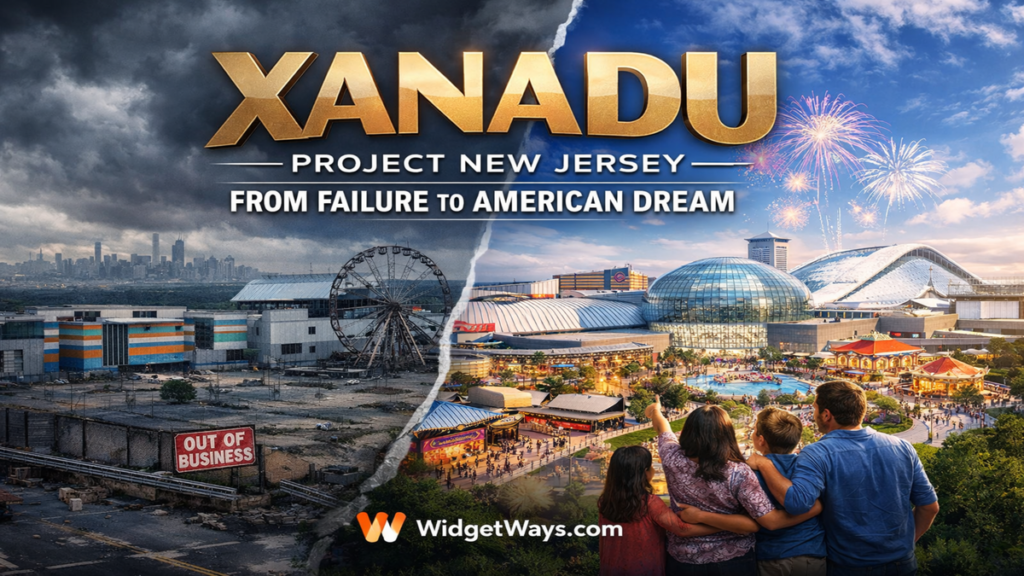

I first encountered the story of the Xanadu project the way many people did: by staring at the enormous, unfinished shell rising from the New Jersey Meadowlands and wondering how something so massive could sit dormant for years. For drivers heading into New York City along the New Jersey Turnpike, the structure looked like a half completed monument to ambition. The dream behind it was simple enough. Developers wanted to build a retail and entertainment destination unlike anything in the United States. Yet the path from vision to reality stretched across decades of political fights, financial collapses, and repeated reinventions.
The Xanadu project in New Jersey began in the early 2000s as a bold experiment in destination retail. The complex was planned as a massive indoor entertainment hub with luxury shopping, indoor skiing, and theme attractions. Within a few years it became a cautionary tale about overambitious development and the fragility of large scale real estate financing.
At its heart, the project reflected a broader shift in American retail. Traditional malls were struggling, yet developers believed immersive entertainment experiences could keep physical shopping alive. Xanadu promised to combine retail, sports venues, amusement rides, and family attractions inside a single complex located beside MetLife Stadium in East Rutherford.
What followed was a development saga that lasted nearly two decades. Ownership changed hands multiple times. Construction stopped and restarted repeatedly. The unfinished structure became one of New Jersey’s most visible symbols of economic uncertainty during the 2008 financial crisis. Yet persistence, new financing, and a revised vision eventually transformed Xanadu into what is now known as the American Dream megamall.
Understanding the story of Xanadu reveals much more than the fate of a single shopping complex. It offers a window into modern urban development, political risk, and the evolving future of retail in America.
The Vision That Began in the Meadowlands
In the late 1990s and early 2000s, New Jersey officials and private developers saw an opportunity in the vast Meadowlands district near East Rutherford. The region already hosted major sports venues, including what is now MetLife Stadium. Millions of visitors passed through the area every year for football games, concerts, and events.
The state’s Meadowlands Commission sought to capitalize on this traffic by encouraging large scale commercial development. The concept was not simply another suburban shopping mall. Instead, planners envisioned a destination attraction capable of drawing tourists from across the Northeast.
The Xanadu project emerged from this ambition. The Mills Corporation, a major shopping center developer based in Virginia, won the right to build the complex in 2003. The proposal promised a hybrid of luxury retail, entertainment, and attractions rarely seen in the United States at the time.
Among its headline features were an indoor ski slope, a Ferris wheel, themed attractions, and hundreds of stores. Developers hoped the project would attract more than 30 million visitors per year.
Urban economist James W. Hughes of Rutgers University later described the scale of the project as extraordinary.
“Xanadu represented the peak of the experiential retail model,” Hughes noted in interviews about the project. “It attempted to transform a mall into a full scale entertainment destination.” (Hughes, 2011)
The Meadowlands location appeared ideal. Situated at the intersection of major highways and just a few miles from Manhattan, the site had visibility and accessibility that few retail centers could match.
Yet the scale that made Xanadu exciting also created enormous financial risks.
Construction Begins and Expectations Soar
Construction officially began in 2004. At the time, the estimated cost of the complex exceeded $1 billion, making it one of the most expensive retail developments in American history.
The structure itself was massive. Covering more than 3 million square feet, the building rose beside the Meadowlands Sports Complex. Its colorful exterior panels were intended to create a distinctive visual identity visible from nearby highways.
Inside, the design called for several unique attractions:
- An indoor ski slope
- A large amusement park
- An observation wheel
- Luxury retail boutiques
- Extensive dining and entertainment venues
Developers promoted the project as a revolutionary hybrid of mall and theme park. The concept was inspired in part by large entertainment malls in Asia and the Middle East.
Don Ghermezian, a member of the family behind the later American Dream redevelopment, would later describe the concept as forward looking but financially vulnerable.
“Experiential retail was always the idea. The problem was timing and financing, not the concept itself,” Ghermezian said in public remarks about the project’s evolution (Ghermezian, 2019).
For several years construction progressed rapidly. By 2006 the skeletal frame of the building had become one of the most recognizable structures in northern New Jersey.
But behind the scenes, financial troubles were already emerging.
Financial Collapse and the 2008 Crisis
The first major turning point came when The Mills Corporation faced financial difficulties in 2006. Accounting problems and declining investor confidence forced the company to sell assets and restructure its business.
As a result, ownership of the Xanadu project shifted to a partnership involving Colony Capital and other investors.
The transition slowed progress. Costs were rising, and the project’s complexity made financing increasingly difficult.
Then the global financial crisis struck in 2008.
Real estate lending collapsed across the United States. Large projects dependent on billions of dollars in financing suddenly faced impossible borrowing conditions.
Xanadu became one of the most visible casualties of the crisis. Construction halted repeatedly, and the unfinished building sat partially completed for years.
For commuters traveling along the New Jersey Turnpike, the dormant structure became a symbol of stalled economic ambition.
New Jersey Governor Chris Christie later referred to the project as a lingering embarrassment for the state.
“That building sat there for years as a monument to government mismanagement and failed planning,” Christie said during a 2011 press conference about efforts to revive the project (Christie, 2011).
By the early 2010s, many observers believed Xanadu might never be completed.
Timeline of the Xanadu Project
| Year | Event | Significance |
|---|---|---|
| 2003 | Mills Corporation wins development rights | Launch of the Xanadu project |
| 2004 | Construction begins | Estimated cost exceeds $1 billion |
| 2006 | Mills Corporation faces financial crisis | Ownership shifts to investors |
| 2008 | Global financial crisis halts progress | Construction stalls repeatedly |
| 2011 | Triple Five Group takes control | Project reimagined as American Dream |
| 2019 | American Dream mall opens partially | Entertainment attractions debut |
| 2020 | COVID-19 delays full rollout | Retail openings postponed |
The Triple Five Group Steps In
The project’s revival began in 2011 when the Triple Five Group took control. The Canadian developer was known for operating two of the largest shopping malls in North America: the Mall of America in Minnesota and West Edmonton Mall in Canada.
Triple Five had experience with large scale entertainment retail complexes, making them one of the few companies capable of finishing the Meadowlands project.
Their approach was to rethink the entire concept.
Instead of continuing under the Xanadu name, the project would become American Dream, a massive entertainment and retail complex designed for tourism as much as shopping.
The plan expanded entertainment attractions while reducing reliance on traditional retail tenants. This shift reflected broader changes in the American retail landscape.
Shopping malls across the country were struggling as e commerce expanded. Developers increasingly emphasized experiences that could not be replicated online.
The Meadowlands complex was redesigned to include:
- A large indoor water park
- An indoor ski slope
- Theme park rides
- Observation wheel attractions
- Ice skating rink
- Luxury retail spaces
This hybrid approach mirrored successful models already operating at West Edmonton Mall.
Yet completing the project still required enormous financing.
Financing the Revival
Financing the redevelopment required a complicated combination of private investment and public support.
The project relied heavily on tax incentives and municipal bonds issued through the New Jersey Economic Development Authority. Critics argued that taxpayers were being asked to support a risky retail development.
Supporters countered that the project could generate thousands of jobs and millions in tax revenue.
Urban development analyst Richard Florida explained the broader context in a 2017 interview about experiential retail.
“Large entertainment retail complexes function more like tourist attractions than malls. When they succeed, they can transform regional economies,” Florida noted (Florida, 2017).
The American Dream project ultimately secured billions in financing through bonds backed by sales tax revenue generated by the complex itself.
Construction resumed with renewed momentum in the mid 2010s.
After more than a decade of delays, the once dormant structure was finally approaching completion.
Major Attractions Inside the Complex
| Attraction | Description | Notable Detail |
|---|---|---|
| DreamWorks Water Park | Indoor water park themed around animated films | One of the largest indoor water parks in North America |
| Nickelodeon Universe | Indoor amusement park | Largest indoor theme park in the Western Hemisphere |
| Big SNOW | Indoor ski slope | Only year round indoor ski facility in North America |
| Luxury retail district | High end fashion stores | Designed to attract international tourists |
| Observation wheel | Large indoor wheel attraction | Visible from inside the complex |
These attractions reflect the central idea behind the project. American Dream was designed not simply as a place to shop but as a place to spend an entire day or weekend.
Opening Day and the Long Awaited Launch
The American Dream complex officially opened its first attractions in October 2019. After nearly fifteen years of construction, delays, and financial turmoil, the doors finally opened to visitors.
The initial opening focused on entertainment attractions rather than retail stores. Nickelodeon Universe and the indoor ice rink debuted first, followed by the DreamWorks Water Park.
The launch attracted national media attention. Many observers were fascinated by the project’s survival after years of setbacks.
Retail analyst Neil Saunders offered a cautious perspective.
“American Dream is an experiment in whether large experiential retail can still thrive in the age of online shopping,” Saunders said in analysis of the opening (Saunders, 2019).
Within months of opening, however, the project faced a new crisis.
The Pandemic Interruption
In early 2020 the COVID-19 pandemic forced the closure of entertainment venues across the United States.
American Dream temporarily shut down only months after its grand opening. Retail store openings were delayed, and visitor traffic collapsed.
The timing could hardly have been worse. The complex depended heavily on tourism and entertainment activities, both of which disappeared during pandemic lockdowns.
Yet the developers continued pushing forward.
Gradually, attractions reopened as restrictions eased. Retail stores began launching in phases throughout 2021 and 2022.
Despite the challenges, the complex remained one of the most ambitious retail and entertainment projects ever attempted in the United States.
What Xanadu Taught About Megaprojects
The story of Xanadu reveals several lessons about large scale development.
First, megaprojects require enormous financial stability. Even small disruptions can create cascading delays when billions of dollars are involved.
Second, political support plays a major role in projects tied to public infrastructure and tax incentives.
Third, consumer behavior can change dramatically over the lifespan of a long construction project.
When Xanadu was first proposed in 2003, shopping malls dominated American retail. By the time American Dream opened in 2019, e commerce had transformed consumer habits.
Developers had to adapt the project to emphasize experiences rather than traditional shopping.
The final result represents a hybrid concept somewhere between a mall, amusement park, and tourist attraction.
Takeaways
- The Xanadu project began in 2003 as a billion dollar entertainment mall concept in the New Jersey Meadowlands.
- Financial troubles and the 2008 global financial crisis halted construction for several years.
- The unfinished structure became one of the most recognizable stalled development projects in the United States.
- Triple Five Group revived the project and rebranded it as American Dream.
- The complex emphasizes entertainment attractions such as indoor skiing and theme parks.
- Its opening in 2019 marked the end of a development saga lasting more than fifteen years.
- The project reflects broader shifts toward experiential retail in response to online shopping.
Conclusion
Reflecting on the Xanadu project today, I see it less as a failed mall and more as a story about persistence in urban development. Few projects endure so many financial collapses, ownership changes, and public controversies yet still reach completion.
The Meadowlands structure that once stood unfinished for years now operates as the American Dream complex. Visitors ski indoors, ride roller coasters, and wander through enormous retail corridors. Whether the project ultimately proves financially successful remains a question still unfolding.
What is certain is that Xanadu left a permanent mark on the development history of New Jersey. It exposed the risks of megaproject financing while demonstrating how adaptive planning can revive even the most troubled ventures.
Large scale retail projects may look very different in the future, but the saga of Xanadu will remain one of the most remarkable development stories in modern American real estate.
Click Here For More Blog Posts!
FAQs
What was the Xanadu project in New Jersey?
The Xanadu project was a massive retail and entertainment complex planned for the Meadowlands in East Rutherford. Construction began in 2004 but faced major delays and financial issues.
Why did the Xanadu project fail initially?
Financial problems at the original developer and the 2008 global financial crisis halted construction and left the project unfinished for several years.
What replaced the Xanadu project?
The project was revived by Triple Five Group and rebranded as American Dream, a large entertainment and retail complex.
When did American Dream open?
The complex began opening attractions in October 2019, with additional retail stores and entertainment venues opening in phases afterward.
What attractions are inside American Dream?
The complex includes Nickelodeon Universe theme park, DreamWorks Water Park, an indoor ski slope, an ice rink, luxury shopping, and various entertainment venues.
References
Christie, C. (2011). Remarks on Meadowlands development and Xanadu project. State of New Jersey Press Office.
Florida, R. (2017). The rise of experiential retail and urban entertainment complexes. CityLab. https://www.bloomberg.com/citylab
Hughes, J. W. (2011). The economics of large scale retail development in New Jersey. Rutgers University Bloustein School of Planning and Public Policy.
Saunders, N. (2019). American Dream mall opens in New Jersey after years of delays. GlobalData Retail Analysis.
The New York Times. (2019). American Dream megamall opens after years of delays in New Jersey. https://www.nytimes.com
NJ.com. (2019). A look inside the long awaited American Dream mall in the Meadowlands. https://www.nj.com